

‘If You Knew Suzy’
Jane Fischer talks about how her daughter lives with disability — and hope and love
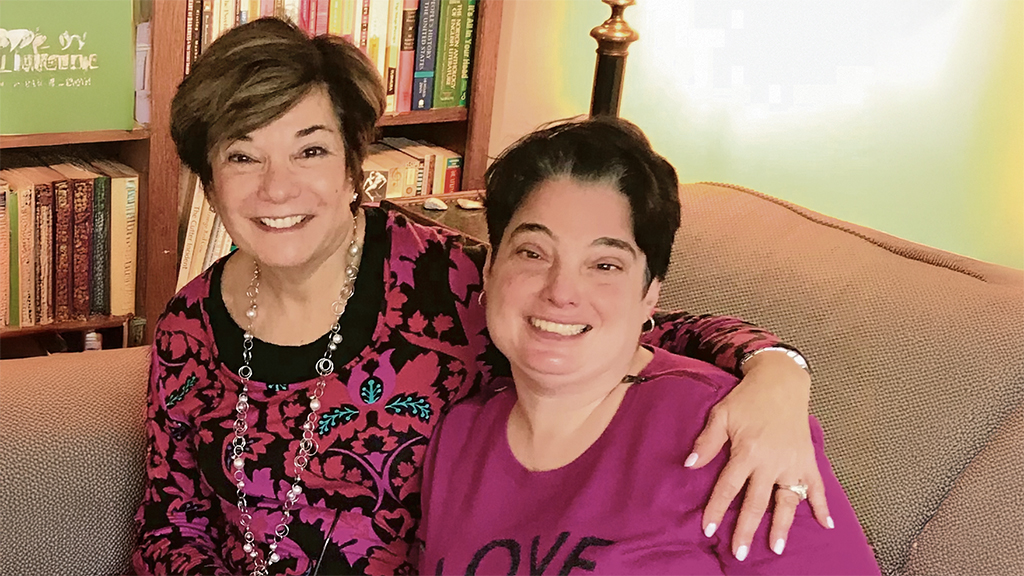
When Jane Fischer’s middle child, Suzy, was born and almost immediately diagnosed with then-unspecified but serious disabilities, Jane went from panic and grief to fierce mother-bear determination.
In the 50 years between Suzy’s birth and now, she and her family have gone through a series of experiences that Jane has chronicled in her book, “If You Knew Suzy: Pushing Past the Boundaries of Never,” written with Carol Ann Ross. (It’s very well written. It’s never mawkish or tendentious; instead, it’s clear-eyed and honest. It earns its rare lapses in sentimentality.)
Jane Fischer will speak at the JCC MetroWest on December 10. (See below.)
Suzy wouldn’t be able to have the life that Jane and her husband, Al, had hoped for, and that their other children, Beth and Ben, went on to earn. She wouldn’t reach the kinds of academic achievements that they’d assumed any child of theirs would have within their grasp. She wouldn’t be able to have a fully independent life. And she wouldn’t be able to have children.
But she could have a life of joy, love, determination, resilience, and accomplishment. By living that way, she could present a role model to other children both either with her disability, the rare Joubert syndrome, or any of the other conditions that other children and their parents face.
And then there is Jane, whose absolute determination to ensure that Suzy gained access to all the treatments and resources available — and that Suzy not only could learn to walk and talk and do all the other things that come naturally to most of us but seemed out of the question for her, but that she’d grow into a kind, loving person who cares deeply about others. (Because, of course, the ability to love and to care deeply has nothing to do with disabilities.)
Jane’s mission — advocating for people with disabilities — didn’t stop with her own daughter. She earned the credentials that allowed her to teach children with special needs, and later she became a learning consultant. She is a public speaker who helps explain both disability and hope. She founded the programs that Suzy needed as her daughter went from baby to toddler to young child to adolescent to young adult and then to full grown-up, and she worked to keep them going once Suzy aged out of them.
Suzy went to Hebrew school, which she loved, and she went to sleepaway camp — because she begged to go, the way her siblings did, because her parents were able to find a camp that was right for her, and because she adored it. She went to special programs and to regular public school, depending on what worked, and for how long.
Suzy had a bat mitzvah at Temple B’nai Abraham in Livingston. She longed for it, she asked for it, she studied hard for it, her parents invited 250 people to it, she read the haftarah and gave a speech at it, and it evoked the kind of happiness that ends in tears of pure joy for most of those 250 people.
Suzy went to college. After college, she lived in a group home through Jespy House, the South Orange-based organization that works with people with disabilities. And Suzy got a job, working with children at Congregation Beth Sholom in Livingston; later, she worked at Temple B’nai Jeshurun in Short Hills. The Fischers are a very Jewish family.
Then, once everything was going well, Suzy developed problems with her kidneys so intense that she needed a transplant. Jane writes in detail about that ordeal as well. Much of the second part of the book details Suzy’s medical problems, which are dramatic, as well as her courage and resilience in dealing with them.
The book ends with the love that suffuses it. It is realistic. Jane and Suzy both live in a world filled with family and friends and organizations and synagogues and activities and hospitals and doctors and emergencies and surprises and contradictions. Jane is straightforward about them. She has fought to keep Suzy alive and happy. It has taken hard decisions and compromises. “I don’t apologize for any of it,” she said.
In an interview, Jane explained why she’d written the book.
“For all of Suzy’s life, I wanted to memorialize it,” she said. “I knew that she wouldn’t have children, and that was very painful to her. I wanted to pass on to future generations what she has accomplished — and that morphed into the book.
She and Al “have started a lot of programs,” she continued. “I began speaking, writing, advising. When you have a special-needs child, you realize that you have to navigate a foreign land. I had to do a lot of research to write the book, and I realized that I was becoming a resource in writing Suzy’s book.
“Her whole life has been about helping other people. My mission became memorializing her life, and showing how if you have special needs — if you have any challenge — you can accomplish so much in the face of adversity.
“The book shows people where they can turn.”
Jane is often hard on herself in the book. She paid less attention to her other two children than she wishes she had, she said. “Whether it’s Jewish guilt or mother guilt, looking back you always wonder what you could have done differently,” she said. “Suzy was my mission. But my other two were my mission too. But there was only one of me. You look back and you wonder, ‘Did I say enough? Did I give enough? Did I listen enough?’
“But Beth and Ben are two wonderful people, even in spite of me. And they adore Suzy. They always have been very supportive, but needless to say, I wish I had done some things differently.”
Then there’s her marriage, which is still strong. “There is no question that you can’t raise a child with special needs and not have it affect your marriage,” Jane said. “The divorce rate among parents of special-needs kids is very high. There were many times when I felt that my husband was saying, ‘Here I am!’ But he hung in there. He is still very much involved. He had to work hard” — having a child with special needs is expensive, and insurance doesn’t always cover very much of that cost — “and it has taken its toll.”
She credits her mother, Bailey Yudkoff, with many different kinds of help. “She was not only my support, my oxygen, and the wind beneath my wings, she also was very influential in keeping my marriage together,” she said. “She understood my husband’s frustration, and she always reminded me of how hard it was for him.”
Both of Jane’s brothers, Marc and Neal Yudkoff, are doctors. Marc Yudkoff, a clinical geneticist in Philadelphia, was able to help with the genetic research that showed that Suzy’s disability is in fact Joubert, and that against all odds both her parents carry it. Both Dr. Yudkoff and his sister urge would-be parents to test for the genetic conditions to which their genes might predispose their children.
Because Joubert is so rare, once Suzy’s was diagnosed, its progress, and hers, have provided scientists with a wealth of information; that’s yet another way in which her life has helped others who will follow her.
Jane tells a story about Suzy’s bat mitzvah. “When Suzy sat down on the bimah, there was a ray of light around her head. My husband said, ‘Take a look at that.’ And then a robin redbreast perched on the windowsill and stayed there for the whole time that she read her haftarah, and a few seconds after she finished, it flew away.
“It was very poignant.”
And despite the odds, it was full of life, love, and hope.
Who: Jane Fischer
What: Will give a talk: “Defying the Odds: A Journey of Resilience, Love, and Triumph”
Where: At the JCC MetroWest
When: On Wednesday, December 10, at 1 p.m.
How much: Free
To learn more and to register: Go to jccmetrowest.org click on calendar, and then click on December 10.