

It’s about resilience
Eli Sharabi describes his ordeal to teens at the Pine Brook Jewish Center

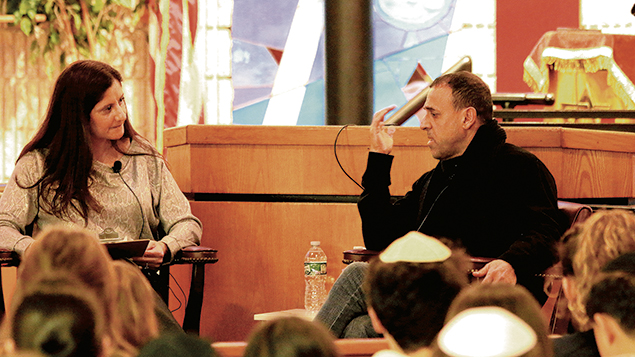
More than 150 teens listened attentively to former hostage Eli Sharabi as he spoke at the Pine Brook Jewish Center in Montville in early February.
The teens — from Pine Brook, Congregation Agudath Israel in Caldwell, Temple Beth Shalom in Livingston, and Temple Sholom of West Essex — learned about resilience from Mr. Sharabi, who was held hostage in Gaza for 451 days.
A few months ago, Mr. Sharabi spoke to students at two day schools, the Joseph Kushner Hebrew Academy and the Golda Och Academy, both in Livingston.
“How this event came about was bashert,” Shari Schwartz, Pine Brook’s religious education director, said. She explained that Emily Fox of the Jewish Federation of Greater MetroWest forwarded a letter from Doron Wesly of Montclair, who has been helping Mr. Sharabi organize local speaking engagements, to the synagogues in the area.
“I saw there was a phone number for Doron, so I called him,” she said. She emailed the synagogue’s executive director, its board president, and the religious school committee, and “everyone thought this was an amazing opportunity to have Sharabi speak to teens at our synagogue.”
Pine Brook’s leaders’ main concern was making sure that everyone would be safe. “We spoke with the town police, as well as the county sheriff’s office,” Ms. Schwartz said; they provided advice that Pine Brook followed. “The federation also provided security for the event,” she added.
The timeline was very tight. The organizers had only a few weeks to plan. The other synagogues were invited to participate, and the talk was set for February 3 at 6 p.m. Sixth- through 12th-graders from all the synagogues were welcome, as well as parents from Pine Brook. The parents sat in the back of the sanctuary so Mr. Sharabi could talk directly to the students
It all came together very quickly, Ms. Schwartz said. The week before the program, she’d met Mr. Wesly, Eli Sharabi and his brother, Sharon, and Meredith Dragon, the federation’s CEO at Liv Breads in Millburn to work out details. “While we were there, the table behind us sent over a platter of desserts because they recognized Eli and were grateful that he had survived,” Ms. Schwartz said.
Two days before the talk, Ms. Schwartz invited all the teens who planned to be there to join in an hour-long call. “We discussed how Sharabi was held, chained in the tunnels, and how he lost one of his brothers, also a hostage, and learned after his release that his wife and two daughters had been murdered by Hamas,” she said. “We wanted them to be prepared emotionally.”
She has two teenage daughters, she continued. “In our home, we talked about October 7, and we all read Eli’s book, ‘Hostage.’ But there is something to be said about hearing directly from him, that we really need to be grateful for the people in our lives because that is what he missed the most.”

At Pine Brook, Mr. Sharabi spoke to the teens about the hunger, deprivation, and humiliation he endured. He urged them to prioritize what really matters, not material things like fancy clothes or cars, but the meaningful relationships in their lives. Ms. Schwartz observed that Mr. Sharabi’s words resonated deeply with the teens. In addition to sharing his story of resilience, he said that from the moment he was kidnapped, he knew he was coming home. He shared that sentiment — the idea that somehow they were going to get out — with the other hostages he was imprisoned with. He was 51 when he was kidnapped; he was by far the oldest of the men who were held with him. Some of them were half his age.
Ms. Schwartz moderated the evening, asking Mr. Sharabi questions. She said that the federation came up with many of the questions she asked. The teens were able to ask questions too, but they had to submit them in advance.
Kevin Reiss of Montville, 18, from Pine Brook Jewish Center, asked Mr. Sharabi about his plans, and whether he would go back to live in Israel. Mr. Sharabi said that before he knew that his wife and daughters were murdered, he contemplated taking them to live in London, away from Israel, because “enough was enough.” But now, he said, he would return to live in Israel. He would not go back to Kibbutz Be’eri, in southern Israel, where he and his family had lived on October 7. There were too many painful memories there, he said. Instead, he will move to central Israel to make a fresh start. He said he loves Israel and feels it is the safest country for Jews.
Other teens asked questions about religion, praying, and the opportunity to escape. Ms. Schwartz reported that Mr. Sharabi said that his brother Sharon was very religious. He is not — but praying took on a hugely different meaning when he was in captivity. Ethan Fahrney of Montville, 12, from Pine Brook, asked whether he had tried to escape. Mr. Sharabi said that he had an opportunity when he was held hostage in a home, at the beginning of his captivity — but then what? He knew he would not make it out of Gaza alive. And then he was moved to the tunnels, where escape was not an option.
Reflecting on Mr. Sharabi’s visit, Alexis Handler of Montville, 18, from Pine Brook, said that hearing someone who endured such trauma discuss resilience put life into perspective. She admired how Mr. Sharabi used hope, good memories, and his inner strength to persevere. “It was so hard to believe that I was seeing Eli in person, after seeing him on my television and social media feeds,” she said. “Part of me was sad knowing the horrors he has lived through and must continue to face. Another part of me was so inspired by the lessons he shared. I was very grateful for this opportunity and will keep it with me forever.”

Sisters Goldie and Sasha Stein of Livingston and Temple Beth Shalom also said they were deeply affected by Mr. Sharabi’s talk.
Mr. Sharabi’s answers were truly inspirational, Goldie, 16, said. “His strength during hardship showed how perseverance is more powerful than hatred inflicted upon the Jewish community. Sharabi’s’ physical and emotional perseverance shows me I can dictate my life even when challenges, minor or large, come my way.”
She said that his testimony served as a testament to Hamas’s brutality. It was more powerful to hear the words of a person who suffered at the hands of Hamas, rather than just reading about it. “It was very emotional,” she said. “I was able to visualize and vividly understand his experience, thus making his story sadder, but at the same time more powerful.” Sasha, 13, echoed her sister’s sentiments, impressed by Mr. Sharabi’s resilience. “He made me realize how much the hostages endured but remained hopeful that they would get out,” she said. “I feel so badly that he was looking forward to seeing his family but could not.”
Ms. Schwartz explained to the teens that they will not fully understand this experience until they are older, and their own children learn about October 7. One day, they will be able to say. “I met with a survivor, and he spoke directly to us.”
Many of the teens were able to take pictures with Mr. Sharabi.
The talk was recorded, Ms. Schwartz said. Teachers will be able to watch it and discuss it with the students.