

Learning Torah through vegetables
Yosef Gillers talks about GrowTorah as Tu B’Shevat nears
It’s winter now. It’s snowy out.
The snow can be beautiful, but by now it’s icy and grimy and grim. The world is grim. There sems to be very little beauty in it.
Even when you look for respite online, you see the news and, really, who wants to do that?
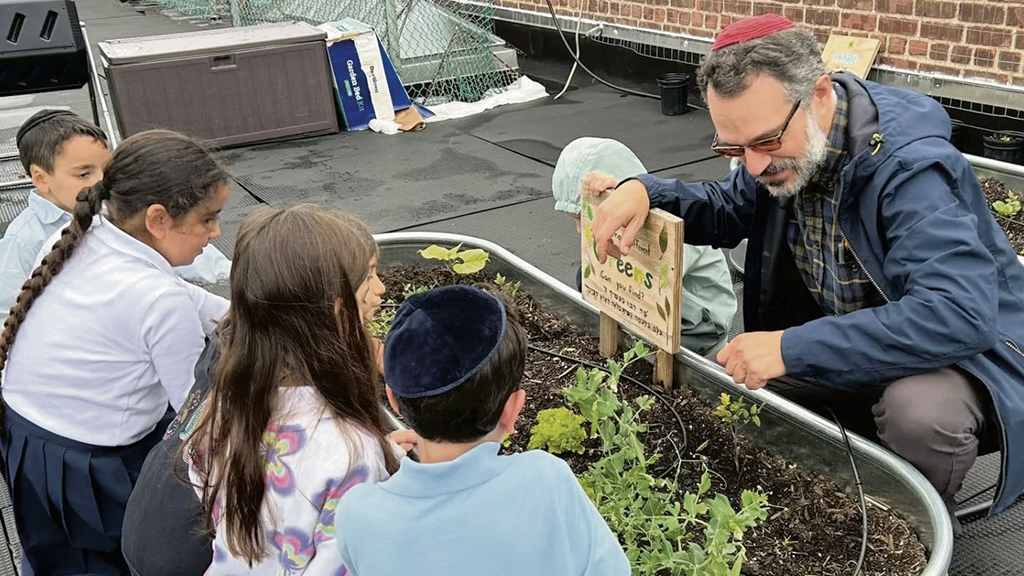
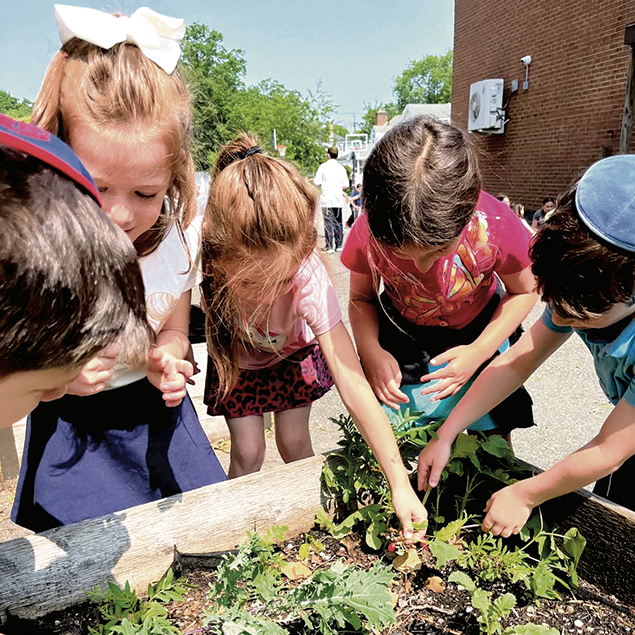
Try going to growtorah.org. You will be confronted with beauty — with children approaching nature, at their level, with awe and tenderness and love.
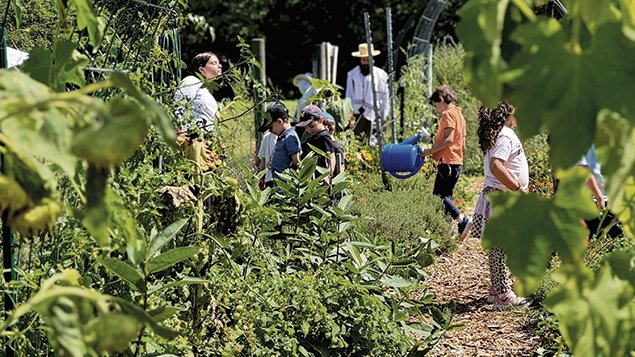
GrowTorah, which is about to turn 10 years old on Tu B’Shevat — you can’t get much better than that — says, “A beautiful world comes with great responsibility.”
Let’s look a little closer at it.
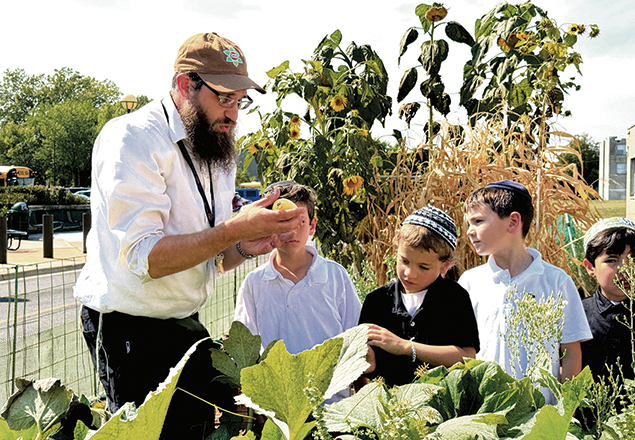
GrowTorah is an educational organization that teaches children in day schools about nature. Put that way, it sounds flat. It’s not. It awakens children to the wonders of nature, and also to their responsibility to it. It ties those responsibilities to the Torah values that underlie its philosophy.
It’s not unlike Tu B’Shevat, which starts on the evening of Sunday, February 1, this year, and ends at sundown on Monday. When we’re children, we’re taught that that day, the 15th of the month of Shevat, is the new year of the trees. Originally it was necessary, according to myjewishlearning.com, because there had to be some way to tell when a tree was old enough to have its fruit eaten. Because it’s unrealistic to think that anyone could mark each individual tree’s birthday, even if you could define that birthday in the first place, the rabbis decided that on Tu B’Shevat, every tree would become a year older.
Now, Tu B’Shevat is also a time of ecological awareness. “In Israel, it’s the time when the sap begins to rise,” Yosef Gillers, GrowTorah’s founder and now its co-executive director, said. “And it’s also when the sap starts rising here. Sugar mapling will start in the next few weeks.” You must mean in Canada, or New England, right, Mr. Gillers? No, he said. “Right here.” There are people in local nature centers who gather sap here.

Both realistically and symbolically, Tu B’Shevat is a great time to have an anniversary. Nothing very visible happens on the surface, but underneath, still invisibly, change is coming. “Midwinter is a great time to start planning nature-related things, whether it’s gardening or any other kind of land stewardship,” Mr. Gillers said. “As soon as the ground thaws, you want to be ready with your plans. Around now, gardeners either start their crop planning or deepen it, and they even start seeding things indoors now.
“That’s why our first class, in an indoor garden space, was at this time of year. It’s the middle of winter, but the ground already is preparing for spring.”
GrowTorah is a mixture of the physical, the tangible, and the practical with the metaphysical and the theological. It’s about how responsibility can interact with beauty to bring joy, and how all of that is Torah-centered.
“Our mission is to cultivate a more passionate, compassionate, and sustainable future driven by Torah values. We do it through nature-based education.”
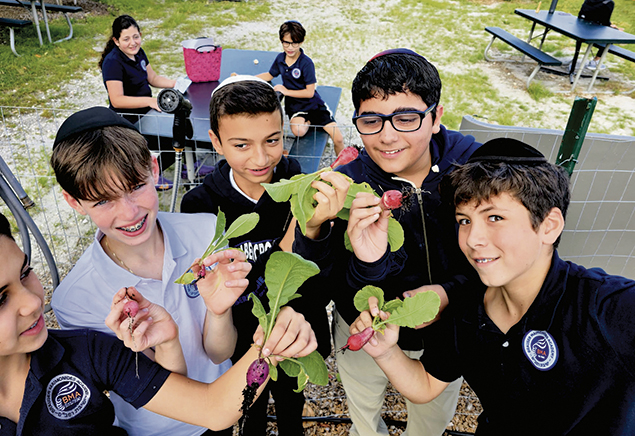
They do that through Jewish day schools, and through partnering with other organizations. Right now, GrowTorah, which is based in Teaneck, works mainly with Orthodox schools, but that’s because the need is greater there. “Many Conservative and community schools already work with the environment,” Mr. Gillers said. “Their staff already is more keyed in.” Now, GrowTorah works with schools and JCCs in North Jersey and Metro-
West in New Jersey; Manhattan, Riverdale, and Nassau County in New York; and Florida, California, Illinois, and other states across the country.
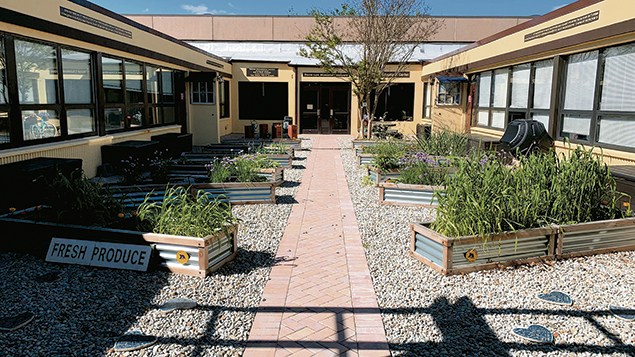
“That’s our demographic,” he said. “We have learned that we can set up a garden in almost any school, almost anywhere, including in schoolyards and on Brooklyn rooftops. That’s a fantastic way to bring nature into the school.”
It’s important to Mr. Gillers that students approach nature with excitement and wonder, not with guilt. While it is necessary to be a good steward of the land, it also is important not to approach that task negatively. His approach is “an antidote to environmental depression,” he said. “We have to start with a positive relationship and positive experience. We’re an antidote and an answer to environmental guilt and environmental depression and climate depression.
“We have developed a pedagogy based on the pasuk in Bereishit” — the verse in the first chapter, Parashat Bereishit, in the Book of Genesis — “that says l’avda u’lshamra,” which he translates as “to work and to protect.” It’s from the part of the story where Adam and Eve are in the Garden of Eden, surrounded by beauty, before anything bad happens.
“L’avda ul’sharma” also appears, in Hebrew, on GrowTorah’s homepage, as images of gardens and children glow underneath it.
That’s the theoretical end of GrowTorah. How did it start? How does it work?
Mr. Gillers grew up in Newton, Massachusetts, the youngest of six children in an Orthodox family. “I had wonderful parents and a wonderful family,” he said. “We went on a family camping trip every summer, and we spent a lot of time outdoors in tents. The trips were mostly in New England, but we took two big trips out West. I hiked the Grand Canyon rim to rim when I was 8.
“Our parents raised us with a deep appreciation for nature.”
His maternal grandmother survived the Shoah, Mr. Gillers said. “For a few weeks she foraged for berries in the forest outside of Warsaw. She has an incredible survival story. My uncle was born as a preemie in the Warsaw Ghetto. He’s still alive; he worked with a historian at Rutgers to turn the story into a book.
“She picked nasturtiums and zinnias for bouquets on Shabbat. I try to have nasturtiums and zinnias in every garden I plant.
“My dad, Bruce Gillers, was a Boy Scout who grew up in Brooklyn. He and my mother, Minna Ann Wasserman Gillers, z’l, both loved nature.
“They were both physicians. When they got married, they went to a Navajo reservation, Chinle, in Arizona. My mother paused her medical training until after I was born, and then she finished. She was a pediatrician.”
The family spent a great deal of time outdoors. “In the summer we’d always go hiking and camping. In the winter we’d go skiing. We spent the four seasons outdoors.”
After high school — Maimonides, in Brookline — Mr. Gillers went to Washington University in St. Louis, where he majored in environmental studies and minored in education. “Then I came back east to study in YU’s smicha program,” he said. He planned to be a rabbi. He studied in the beit midrash for five years, “but I didn’t finish,” he said. “I decided that I would start GrowTorah.
Where did the dream come from? “I’d worked in Bnai Akiva camps and for NCSY, on their Shabbatons, and I worked in summer camps. I worked in an amazing frum boys’ wilderness camp that moves around but at the time was housed in Camp Dora Golding in the Poconos. I saw the transformative power of these experiences. I saw that experiential informal Jewish education is super powerful. And it’s all nature-based. I wanted to do something like that.”
So he did.
First, he needed support, so “I picked up two wonderful rabbinic advisors, Rabbi Yosef Blau and Rabbi Jeremy Weider,” he said. “They’re both still involved.
“It’s always been really important to know that we have the rabbinic authorities so we can ask questions and make sure we’re doing it right. That we’re staying within the bounds of the community, so that we can be well received, we can stay relevant, and we can really have the impact that we seek to have.”
When he first started GrowTorah, Mr. Gillers worked alone, “but we are mission-aligned with plenty of other organizations.
“I approached Hazon,” the Jewish nonprofit that works with the environment. “I approached Nigel Savage,” its creator and until recently its CEO, “and he gave me his blessing,” Mr. Gillers said. “Hazon’s been a supportive, wonderful collaborative partner. And we also were in the Orthodox Union’s Impact Accelerator. We were in its first cohort, and it was phenomenal. We have amazing organizational partners.”
So okay, but how did he start?
With four high schools and a dream. “I had a vision,” he said. “I imagined a farm-based yeshiva, but this was more practical. It was doable. I had four schools saying that they would pay me what I need to do the thing I want to do, which is to teach nature through vegetables.
“I got $10,000 a year from each school, and I had side gigs. It wasn’t really a leap of faith to do it. I knew that I could get paid what I needed, and I had to try it. My wife gave me a year.”
So he did. “And the rest is history.”
Mr. Gillers started with high schools, but “I discovered that though there’s incredible educational value to doing this in high schools, there also are horrible logistical impossibilities. So we did it in high schools for a few years, but then we realized that we can do much more in elementary schools.”
That’s where GrowTorah focuses now.
Until just a few years ago GrowTorah was just Mr. Gillers, but now he has a staff of eight. “We are an educational organization,” he said. “We use gardens and nature to teach, but we hire educators first and foremost. We look for educators before gardeners, although it’s necessary that they love nature. But if they can’t teach that love to the kids, then it doesn’t matter if they’re a talented or passionate gardener or farmer.”
GrowTorah focuses its work with elementary school kids on the weekly Torah portion. For these weeks, when the Torah focuses on the plagues that the Egyptians faced in Egypt, it focuses on “how God twists and bends the laws of nature to do these miracles. We concentrate on seeing what the laws and cycles of nature are, and how they are twisted.
“In Parashat Bo, which we read last week, we focus on locusts and pests. They are incredibly destructive in a garden. We always have to deal with pest management.
“If I were talking to kindergarteners, I would teach them that we have a lot of bugs in gardens. Some of the bugs are good, like ladybugs and butterflies. Some are pests. How can we design our garden to be a home for the good bugs and keep the bad bugs away?
“We use locusts as a conversation starter. It’s a real, valuable, concrete lesson for our gardens and beyond. How can we approach our relationship with nature and with pests? God created all these bugs. How can we do the least amount of harm to accomplish our needs?
“And there are miracles in these parshiot. But we don’t live with miracles. So how do we do our job? We believe that God will take care of us, but we have to do our part. For young kids, we teach that that is why we have to weed the plants. We can’t expect God to weed them for us. And we get into more complex conversations with older kids. That’s why we have halacha to teach us about caring for the environment. We can’t rely on HaShem for everything. We have to do our part. We can’t trash the environment.
“The theme is emunah. Faith. We believe that HaShem will take care of us — but we have to do our part.”
GrowTorah is celebrating Tu B’Shvat at Flat Rock Brook Nature Center in Englewood on Sunday, February 1, from 10 a.m. to 1 p.m. The day is cosponsored by a long list of Orthodox shuls in Bergen County.
A reservation is necessary; go to www.growtorah.org/bday. Or go to GrowTorah’s website, explore its many offerings, and then click on Dig In, at the menu at the top of the page. Then click on Events.