

Loss, terror, resilience, and hope
Rescued hostage Eli Sharabi speaks at Rutgers Hillel
To get to the talk, you have to walk through the campus at Rutgers in New Brunswick.
You see massive snow mounds, somehow still looking more or less white because it’s dark out and they’re sparkling. You see students, walking in groups, shouting and laughing, walking in pairs, talking intently, walking alone, either looking at their phones or absorbed in whatever’s coming through their earbuds. The stores and university buildings are lit, everything looks clean and inviting, and all seems to be good.
You get to the Hillel building; the security is real but unobtrusive, everyone’s not only polite but warm, and it’s all full of life.
You go upstairs to the big room that seems smaller because it’s packed with people, almost 240 of them, overwhelmingly students, so in their late teens or early 20s, with a sprinkling of older adults. Everyone’s talking. The mood’s good.
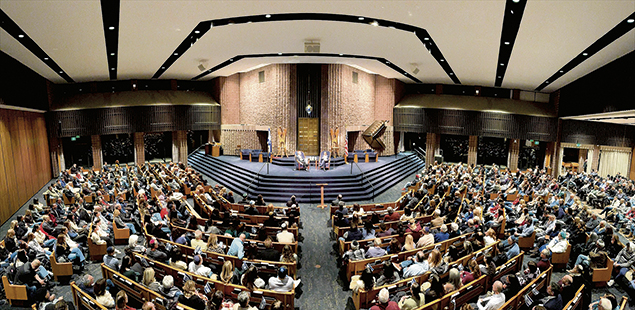
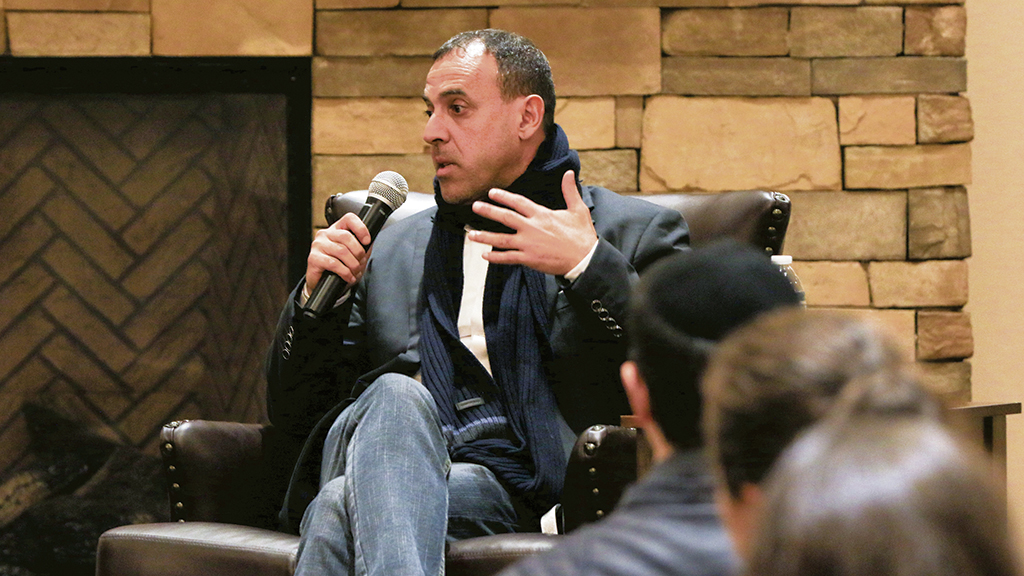
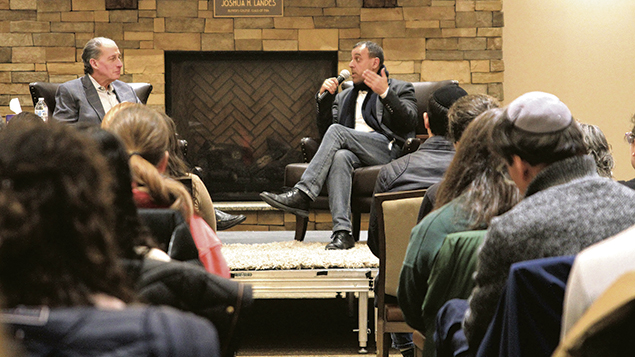
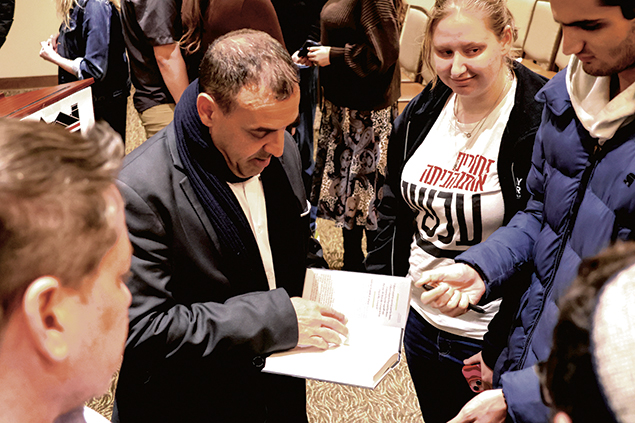
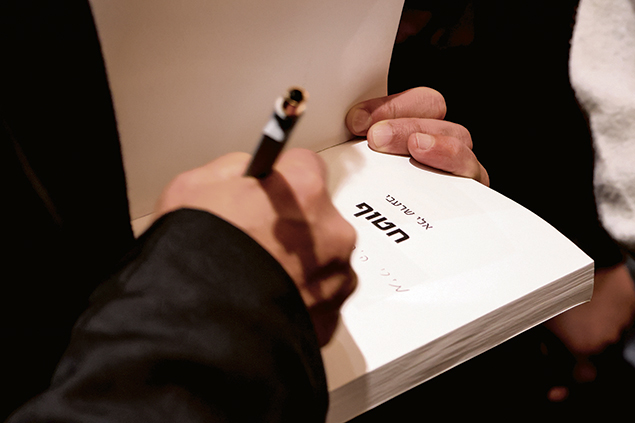
The program begins. Eli Sharabi, the Israeli hostage who was released after 491 days in captivity, most of them in tunnels under Gaza, and who wrote the starkly titled “Hostage” detailing those endless nightmare days, speaks.
He’s interviewed by Alan Chernoff of South Orange, a prominent journalist who also is the son of a Holocaust survivor, and who co-wrote a memoir, “The Tailors of Tomaszow: A Memoir of Polish Jews,” with his mother.
And the room is dead silent. Not a single chair squeaks. No one rustles a page or crumples a bag. No one sneezes. No one moves.
We are in the presence of a soft-spoken, handsome, fit-looking 53-year-old man with huge dark eyes who has survived horrors that we cannot imagine — that we do not want to imagine — that were willfully inflicted by other human beings — and has come out of that ordeal still somehow hopeful. Realistically hopeful. Changed and battered and bereft and beaten — they beat him and the others relentlessly — but not beaten. Still looking to the future. Not traumatized. Astoundingly resilient.
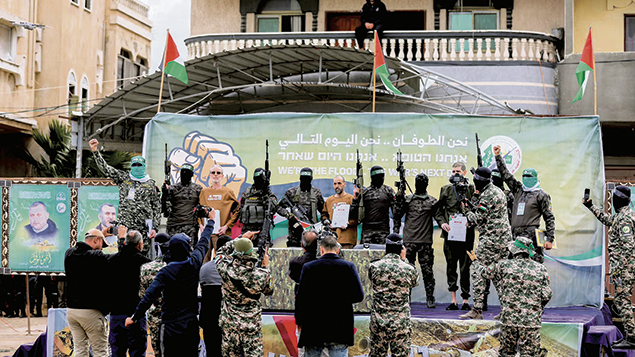
Mr. Sharabi’s story, in both his book and his talk, began on the morning of October 7, as the family hid in their safe room on Kibbutz Be’eri, increasingly frightened as texts and the TV in the room started transmitting panicked messages and narratives. In his talk, and even more in the book, the horror intensifies quickly. Eli is kidnapped, as he assumed he would be.
He also assumed that his wife, Lianne, and their daughters, Noya, 16, and Yahel, 13, would be safe, protected by their British passports; Lianne was born in the U.K. He didn’t know then that the three of them were murdered, burned alive in their safe room, killed so brutally that it took DNA to identify their bodies. His assurances that he’d be back as he was pulled away were the last time he talked to them.
Oh, and the terrorists also shot and killed the family’s dog.
Mr. Sharabi spoke quietly, holding the microphone close to his mouth. His tone was even as he described both physical and psychological torture, humiliation, and constant starvation. He was held with other Israeli men; they were chained together. He talked about how he was twice their age, and took care of them, providing a role model as they faced overwhelming fear and had to negotiate personal friction to live together as they did.

He was in the Israeli navy, he told us, and after that he was in intelligence. He used his training, allied with what clearly were his inborn intellectual gifts and what seems like preternatural self-control, to analyze each situation. He said that as soon as he was kidnapped, all his analytic skills kicked in; they helped him predict what might happen. He used his inborn talents and learned skills to analyze and understand his captors; because they were human, they had foibles and weaknesses. He could foresee some of them and use them to his advantage.
He speaks Arabic, so he could understand his captors, talk to them, and translate for the other hostages. He’d sometimes stay awake at night to listen to what they said to each other when they assumed the hostages were asleep, he said, and he gained some insights into them that way.
Mr. Sharabi talked about how his captivity began in a Palestinian home, where he was treated relatively well — the word “relatively” is doing a lot of work here — and then he talked about the tunnels to which he and other hostages were relegated. He talked about the progressive starvation, and how their keepers wanted them on the verge of death but still alive; their usefulness as instruments of leverage would be gone if they died. He talked about being beaten until his ribs were broken, and about how hard it was to get to a toilet.
After describing how he was taken from his family, he didn’t talk about them, or about his brother Yossi, whose death he learned about just two days before he was released. He said that one of the ways their captors tortured him and the other hostages was to tell them that their families no longer remembered them. That no one cared. He knew that was not, could not, be true. But it wasn’t until he was released, when he was told that his mother and sister would meet him, that he knew that Lianne, Noia, and Yahel were dead.

Since then, he told us, he has devoted his life to telling the story and working for the hostages’ release — something that happened just last week, with the return of the body of Ran Gvili, the last hostage still in Gaza. He became a tireless advocate for all of them still in captivity, and most particularly for Alon Ohel, the young Israeli pianist taken from the Nova music festival. The two men became extremely close. Mr. Sharabi was released before Mr. Ohel, and he dedicated himself to winning his friend’s release. The piano in Hostage Square in Tel Aviv was his. Mr. Ohel eventually was freed; Hamas held him for 737 days.
His life has changed now.
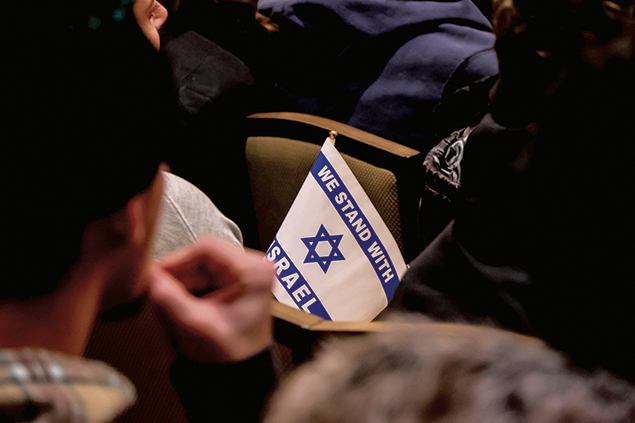
When he finished talking, finally there was noise. Applause. A standing ovation; the audience waved the little Israeli flags that had been left on the chairs.
This meeting at Rutgers was in the middle of a local tour, supported by the Jewish Federation of Greater MetroWest. Mr. Sharabi wants to talk to Jews, but not only to Jews. He’s been at the Joseph Kushner Hebrew Academy in Livingston, the Golda Och Academy in West Orange, and Gottesman RTW Academy in Randolph. He’s also been to the Pingry School in Bernards Township, the First United Methodist Church in Westfield, and Our Lady of Sorrows in South Orange.
He’s spoken to adults from the community in Temple B’nai Jeshurun in Short Hills and Temple B’nai Abraham in Livingston, and to high school students at the Pine Brook Jewish Center in Montville and at Temple Har Shalom in Warren.
He’s been speaking around the country — he began his tour at Temple Emanu-El on Fifth Avenue in Manhattan, and he plans to continue those talks.
“It was an honor to interview him,” Allan Chernoff said.
He’d already read “Hostage” and heard Mr. Sharabi at Temple Emanu-El; he prepared for the evening at Rutgers by reading the book again, he said. “He is an exceptional person. Clearly he was very well trained in the Israeli military. Because of intelligence work, he anticipated what would happen, and as soon as it happened he was on a mission.

“He said, ‘I became Eli Sharabi, survivor. My mission was to survive.’
“He was very focused on it. He was extremely disciplined and constantly analyzing his captors, recognizing who to ask for food, who to ask for a favor. He played their captors. The hostages had extensive discussions about what to do. They made sure not to anger them, not to disagree with them, to nod their heads at them.
“Eli had incredible self-discipline. He mentioned that late one night, he was offered a little bit of extra pita. He was starving. But they wanted him to recite a few lines from the Koran for that morsel of food, and he refused, even though he was starving.
“What I really wanted to bring out was that he is a model of resilience. For kids in today’s environment — for everyone always, but particularly for Jewish kids in today’s really fractured environment — I think that resilience is important.”
Mr. Chernoff saw some similarities between Mr. Sharabi and his own mother, Rena Margulies Chernoff. “Eli is a survivor, and I come from a family of survivors,” he said. “I made that connection, and I really respect his great ability to survive, because I know how challenging that is under such extreme circumstances.
“And not only to survive, but to bounce back. My mom,” who survived Auschwitz, “was able to recover and go on to live a productive life, raise a family, have a career. Eli is bouncing back. That doesn’t mean that he’s not mourning the loss of his wife and daughters, but he is moving forward.
“That is a healthy response to a horrific tragedy, and it is an astounding accomplishment. We should never minimize it. It is so very difficult.”
One of the questions Mr. Chernoff asked Mr. Sharabi was whether it was difficult talking about what happened to his family and to him. No, the answer came; it’s functioning as a kind of therapy.
Mr. Sharabi said that he does work with a therapist, and that he is lucky in that he does not suffer from PTSD. Many released hostages do, he said, but he is not among them.
Mr. Chernoff believes that not only telling his story but being received as he has been is a kind of therapy. “You saw the ovation,” he said. The utter silence, too, is inherently supportive.
Much of that silence, and the ovation when the audience was released from the silence, was awe.
“Eli’s story is beyond any TV drama,” Mr. Chernoff said. “He lived through unbelievable torture, it is realer than real, and here you are, seeing him in the flesh and hearing directly from him. And he doesn’t focus on the torture or the hunger, but on the strategy he used to survive.
“He said to me before the event that anyone could have survived it. Anyone could have done it. I don’t really buy that. He is strong, and he carried the three kids who were with him through it.
“He helped them survive.
“And then when he and the others were released, and Alon wasn’t, it was devastating for Alon. His deepest fear was that he’d be left alone. Eli said that he would do everything he could, and he followed through on that commitment.
“Eli really was a leader. He was father figure for these young guys.
“You see actors portraying spies or superheroes. But Eli Sharabi —he’s a superhero in the flesh. He’s the real thing.”