

Never again!
A first-hand account of ‘Nuremberg’ and its reception at San Sebastian in Spain
It’s a hard time to be Jewish in Europe.
Okay, maybe that’s not news. It’s never been particularly good to be a Jew in Eastern Europe, and only occasionally in Central Europe. But after the war (because even 80 years later, World War II still is “the war”), it seemed that being Jewish in Western Europe was just fine.
According to Alexander Smukler of Montclair, who grew up behind the Iron Curtain, leaving the Soviet Union just months before it imploded, it’s not so good in Western Europe right now either.
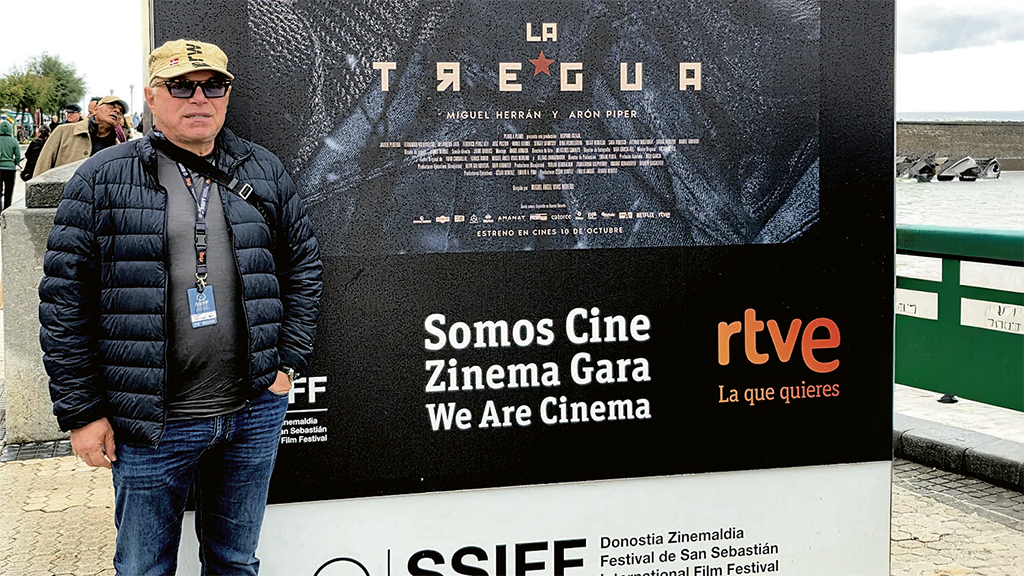
Mr. Smukler is in Spain for the San Sebastian International Film Festival. That festival isn’t as big or well-known or influential around the world as Cannes or Sundance or Venice or Berlin or Toronto, but it’s still a major event in Europe.
He was at the festival as an accredited guest of the Wende Museum in Culver City, California. The museum specializes in the Cold War; Mr. Smukler donated a collection of samizdat (hand-copied underground-delivered texts) there, loaned it art by Soviet Jews from his collection, and in general is a Wende friend.
The museum sent guests to San Sebastian because of the film called “Nuremberg,” which was shown at the festival, and about which Mr. Smukler raves. But we’re not there yet.

On his way to Spain from Montclair, Mr. Smukler stopped first in London. The day before his visit, there had been “a massive demonstration in the U.K.,” he said. “They raised Israeli flags, and generally the attitude was to support Israel.” (That demonstration was organized by Tommy Robinson, the extreme right-wing agitator whose anti-Muslim rhetoric has started to attract some British Jews.)
But the day that he got to London, “there were a number of demonstrations, with thousands of people, with Palestinian flags. There were very anti-Israel and antisemitic slogans.” It was ugly, Mr. Smukler reported.
There also were mass demonstrations against Israel across Italy on Monday, September 22. Tens of thousands of anti-Israel demonstrators marched in Rome, Reuters reported; police fired tear gas at protesters at the central train station in Milan and used water cannons against them at the port in Venice. All the protests were against Israel’s actions in Gaza.
Mr. Smukler talked to me from San Sebastian, where two films, “Nuremberg” and “The Voice of Hind Rajab,” were vying for the San Sebastian audience award. That film, which won the Grand Jury prize at the Venice International Film Festival, is, according to Wikipedia, the story of “Hind Rajab, a five-year-old Palestinian girl who was killed by the Israel Defense Forces during the Israeli invasion of the Gaza Strip.”
“It has so many supporters here in San Sebastian,” Mr. Smukler said. “There are many hundreds of people marching in this Basque city, which is full of Palestinian flags. There are well-organized, well-supported demonstrations for the film, and for a Palestinian state. The demonstrations all look anti-Israel, and antisemitic.”
There is a local custom in San Sebastian that Mr. Smukler described. “I saw it on the beach this morning,” he said. “In this little town, they have their own Twitter. Somebody writes the day’s major news on the sand on the beach.

“Every day, a group of volunteers writes the major world news and the town news in the sand. And today, it’s dedicated to calling for a full embargo of Israeli products.”
There are signs all over the town’s walls that call for the embargo, he added. They’re in both Spanish and English.
The film he was there to support, “Nuremberg,” is from a completely different world. “This is a mind-blowing movie,” Mr. Smukler reported. “I think that everybody who reads your newspaper needs to and must see this movie.”
“Nuremberg” was greeted by a four-minute standing ovation at the Toronto International Film Festival, which apparently is unusual. “Standing ovations at the Toronto International Film Festival are quite rare,” Deadline reports. “Even a quick one minute up-and-down is a big deal.”
The film did not do as well in San Sebastian. It did not win the audience award, which in itself is not a big deal. Someone wins, someone else loses. But the way it lost is telling.
“It was the most unpleasant situation during the closing ceremony because every award recipient began their speech by supporting Palestine and condemning Israel,” Mr. Smukler said. “The audience was very, very active, supporting anti-Israel speeches.

“The master of the ceremony was simply disgusting. He constantly made stupid jokes about Netanyahu and Trump. And nobody even mentioned anything about Ukraine and the war in Europe,” which is being fought far closer to home for the San Sebastian natives than the war in Gaza.
“Many people brought Palestian flags inside the ceremony,” Mr. Smukler continued. “No one was holding an Israeli flag. I was very upset that I did not think about it ahead of time, and I did not take an Israeli flag with me.
“I felt like I was back in the Soviet Union in 1978, surrounded by Jew- and Israel-hatred.”
Then there was “Nuremberg.”
“Nuremberg’s” writer, co-producer, and director, James Platten Vanderbilt, doesn’t have the background that makes his eventual immersion in a project that isn’t directly about the Holocaust but inextricably tied to it seem inevitable.
Mr. Vanderbilt, whose film credits include writing “Zodiac” and “The Amazing Spider-Man,” is one of the Vanderbilt Vanderbilts. He’s descended from Cornelius Vanderbilt, the robber baron who built the family, along with railroads and other infrastructure, as well as a massive fortune. His lineage on both sides is high Protestant old money. “But he shot that movie with an extremely strong pro-Jewish sentiment,” Mr. Smukler said.

Based on “The Nazi and the Psychiatrist,” a 2013 work of nonfiction by Jack El-Hai, it tells the story of Douglas M. Kelley, the U.S. Army psychiatrist who was tasked with working with Hermann Göring and other top Nazi officials. The goal was to study and understand how and why they were capable of the enormous evil they had unleashed on the world. “How did they come to the idea of the Final Solution?” Mr. Smukler said. “How did they become the monsters who were able to create the death factories that executed six million Jews and millions and millions of other people?”
The film stars Rami Malek as Dr. Kelley and Russell Crowe as Göring.
“During the trial, those leaders of the Nazi party all denied that they knew about the death camps and the extermination of the Jews,” Mr. Smukler said.
“There is a story inside the movie about a Jewish boy who escaped from the Holocaust. His family was killed in Auschwitz. The story was that the whole family could have been saved if they could get visas to get into the United States, and they did, but even then they did not have tickets for the whole family. They could buy a ticket only for that one boy. And he became a soldier, and a key interpreter between the psychiatrist and the Nazi leaders.”
His name in the movie is Howie Triest, and he’s played by rising British film star Leo Woodall.
“The story of that boy is mind-blowing,” Mr. Smukler said. “And it is the story of people like me, people of my generation, who came through the Iron Curtain. Who came from slavery to freedom. They will always stand for freedom.
“The boy said, ‘I am doing this because I don’t want this to happen ever again.’ The message that I personally adopted from the movie is that this is the reason for the creation of the state of Israel. This is what modern Jews have to understand. We must be strong.”