

One battle after another
Our analyst takes another look at the Middle East, Russia, Ukraine, China, and the U.S.
As he looks back at the events of the last three months, Alexander Smukler of Montclair, who began his work with us by analyzing the situation when Russia invaded Ukraine in February 2022, sees a series of moves on the huge chessboard on which the global game of thrones is played.
It’s happening in a way that Mr. Smukler — who was, among many other things, not only one of the youngest refuseniks but also a chess master before he left the about-to-topple Soviet Union in 1991, half his life ago — had predicted. But as life has taught him, nothing is certain.
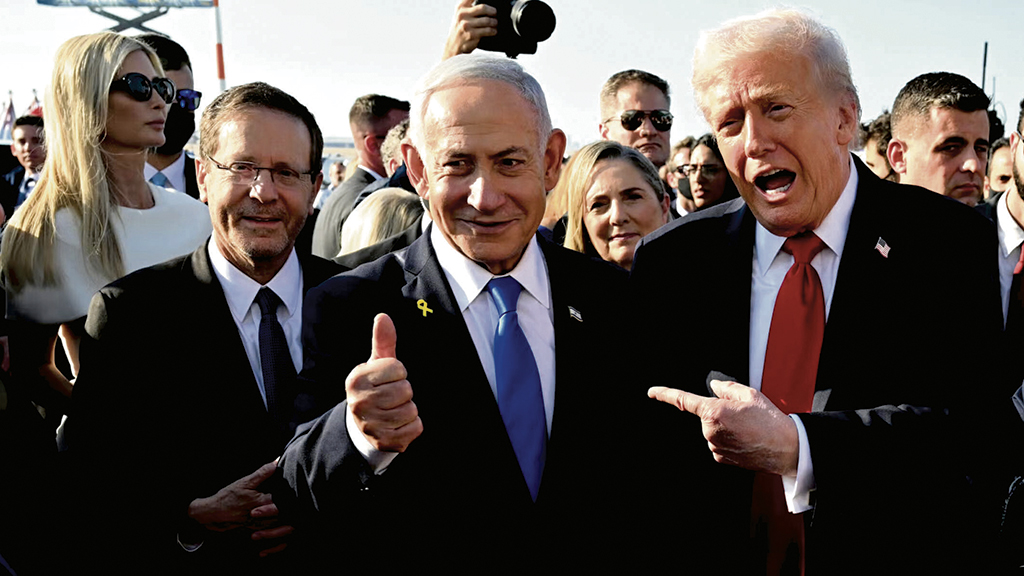
Although what he called the “so-called” peace treaty that President Trump brokered between Israel and “the major Arab players in the Middle East” saw the release of the last 20 living hostages who Hamas had kidnapped from Israel and hidden in tunnels under Gaza — “thank God,” Mr. Smukler said as he mentioned them — “and I applaud the first phase, at the same time I have a bad taste in my mouth. I am pessimistic about the future implementation of the 20 stops on the roadmap to peace.”
“Although I applaud Jared Kushner,” Donald Trump’s Jewish son-in-law, who grew up in Livingston, “and Steve Witkoff,” the Jewish real-estate developer from Long Island who is Trump’s envoy to the Middle East and Russia, among other places, he doesn’t believe that Hamas will live up to its side of the bargain, he said.
As he has said since it happened, and predicted, in general rather than specific terms, since the war in Ukraine started, “the Middle East crisis would not have started, and October 7 would not have been possible, or have been as tragic, unless Russia would be the biggest beneficiary of the turmoil.
“I believe that what happened on October 7 was cooked somewhere near the Kremlin.
“For me, the bottom line is that the first phase of the peace treaty in Israel was very positive, but I am far from thinking that this peace will continue.
“It reminds me of the announcement of the great victory over Iran in June. We live in a very busy world, so that people already may have forgotten that bombing Iran left us with unanswered questions. Where are the 400 kilograms of highly enriched uranium that disappeared? We still don’t know where those stockpiles are. We do know that the bombing in Iran did not end up as a great victory for Israel or the United States. The Iranian regime still exists. It is still supported by Russia. It is recovering and it is still dangerous. Obviously, it will continue to enrich uranium, and to move forward to a nuclear bomb. So some work was done on the problem” — that is, on the threat that is the continued existence of the Iranian regime — “but it is not finished.”
Next, Mr. Smukler returned to the hastily arranged August summit between Trump and Putin in Anchorage. “It was promoted and organized very quickly, and as we know, it ended up with no significant result, but we don’t know what Trump and Putin discussed. All the commentators are guessing. Nobody knows the details. But we do know that it didn’t bring any changes to the war in Ukraine. But it had significant effect and meaning in terms of my theory that the three world leaders — Trump, Putin, and Xi Jinping of China — are paving the road to Yalta 2.
“Now they’re busy flexing their muscles, like big, old gorillas, showing that they still have what it takes, trying to impress each other.” With nukes.
Of course, this could all change. All three leaders are old, declines in physical health and mental capacity is unsurprising, and life is entirely unpredictable. But some things are clear.
“The road there is very bumpy, and the trip will not be easy. Remember the yellow brick road in ‘The Wizard of Oz’?” Like that road, Mr. Smukler suggested, the road to Yalta 2 will be full of unexpected hazards, winged monkeys, and fields of poppies that put everyone to sleep. But “I predict in the next three years, before the end of Trump’s term, they will meet and try to rewrite the rules of coexistence for the next three quarters of the 21st century.”

According to Mr. Smukler’s theory, a conference between those three world leaders, like the meeting between Franklin Delano Roosevelt, Winston Churchill, and Josef Stalin toward the end of World War II, which set the world order that more or less kept the peace for 80 years, will establish the new world order that’s been emerging, all red-faced and bloody, as the tectonic plates shift beneath all our feet.
The meeting in Anchorage, Mr. Smukler said, “gave Putin a unique chance to get out of the corner” in which he’d imprisoned himself with the disastrous war he began in Ukraine, imagining it to be a cakewalk and finding it instead a quagmire. But still, that meeting, “in terms of the Russia-Ukraine conflict, brought zero results. That’s why Trump canceled the press conference and had no communiques about it. And as we know, Trump was going to give Putin another chance as they met in Budapest.
“That meeting was brokered by Orban,” Hungary’s strongman leader, “who wanted to play a significant role. He’s very pro-Putin, the only European leader with that stance.”
Why was that meeting, set for late October, canceled? “Commentators are saying that it’s because Trump wasn’t happy with the developments on the front lines in Ukraine, and Putin’s bombing civilians in Ukraine, but I think it was simply because it was almost impossible logistically for Putin to get there,” Mr. Smukler said.
“His plane would have to cross several countries that not only are part of the International Criminal Court,” which has an arrest warrant out for him, “but also didn’t guarantee that his aircraft wouldn’t be shot down by Ukrainians, Poles, Romanians, or others.
“It would be much more logistically complicated for Putin to get to Budapest than it was to get to Anchorage” — where he was able to fly from Russia to Alaska without crossing over any other countries — “and he’d have to take enormous risks. So although it would have been a tremendous diplomatic achievement for him to get to that summit, we know that the angry dwarf,” as Mr. Smukler calls Putin, “is not a brave guy. He’s not willing to take even the slightest risk to his life, because he knows better than anyone else how an enemy could be eliminated in the 21st century.” Indeed, Putin’s past is littered with corpses, most notably with that of

Yevgeny Prisozhin, the head of the Wagner Group, who mutinied against Putin and whose plane fell out of the sky just months later.
Hungary does not have a border with Russia, so any flight getting Putin there would be complicated. “Remember that since the war started and there is a warrant out for Putin, he’s gone only to Mongolia and China, which border Russia, and to the United States, where it’s basically the same thing.
“So I think that it was not Trump but Putin who canceled that meeting,” Mr. Smukler said.
“On the global scene, we see that Putin is increasing his efforts to destroy Ukraine as soon as possible, and that makes Trump unhappy, or at least he wants it to look like that in public.
“That pushed Trump to do an important thing. Just two weeks ago, he announced that he would implement severe sanctions on Russia by sanctioning its two most powerful and effective oil companies, Rosneft and Lukoil.”
Wait. What? Weren’t Russian oil companies sanctioned already?
“It’s an interesting question,” Mr. Smukler said. “For the last three years, I have been 100 percent certain that these two companies are under sanctions, and I was very surprised to suddenly realize that they have never been sanctioned by the U.S. administration.
“These two companies sell Russian oil, and they did even after the war started and the sanctions were imposed. They sell oil to Turkey, to Malaysia, to Indonesia, to India, and to China. My question is why these two companies were not under sanction.
“Both of those companies have substantial assets across the world, in Europe, and Lukoil has assets in the United States,” as any of us who buy gas at gas stations — all of us! —know.
“But those sanctions were implemented now, just about two weeks ago, and it’s been really painful for the Russian economy already.”
How did it happen? It’s complicated, but “we know that there are several countries, especially China and India, that have been buying Russian oil using tankers that Russia rents or buys from other countries. We call it the gray fleet. They provide the logistics of the oil trade under the flags of other countries, including many in the Pacific and the Caribbean. Russia used these tankers to bring oil from ports in the Far East and the Baltics, going to India and China.
“That’s how India and China have been buying a huge amount of Russian oil. Until just now, they have been buying 2.6 million barrels of Russia oil a day. Every day. Two point six million barrels.”
Why was this allowed to happen? Mr. Smukler posits that “the Biden administration didn’t put sanctions on these two companies because cutting off the Russian oil supply would have drastically increased the price of oil in the United States.” Biden and his cabinet did not want to drill for oil in the United States, and they didn’t want the price of oil to rise, so they chose instead to overlook where the oil entering the country came from. “But Trump says ‘Drill, baby, drill!’ so oil production in the United States is increasingly dramatically. And Saudi Arabia announced that it can increase its oil production if Russian oil disappears from the world market.
“Oil-producing countries have announced that they can easily increase oil production up to 2.5 million barrels a day to supplement the Russian oil already on the world market a day, which eventually will replace Russian oil on the world market, and nobody will even notice when Russian oil disappears from the market.
“That’s a huge accomplishment of the Trump administration.”
The tariffs that Trump has instituted have affected India’s economy, Mr. Smukler continued. “India was making $17 billion profit per year by buying Russian oil, refining it, and reselling it, but then Trump implemented the tariffs. India got very angry, but eventually it started to cooperate, and to decrease the amount of Russian oil it bought, because it would be losing $50 billion per year, far more than it was making.” Rational self-interest made the decision clear, even though the tariffs seem to be imposed and changed and withdrawn at President Trump’s whim rather than as the implementation of a clear strategy.
China is a different story, and that’s because China’s currency, the yuan, unlike India’s rupee but like the American dollar, is a hard currency.
“That means that when sanctions are implemented, countries cannot buy or sell or get payment for oil in dollars. And everybody who pays in dollars will automatically be sanctioned by the United States. So these two Russian oil companies can sell their products and receive payment in any currency except dollars.”
China can keep on buying Russian oil, at increasingly huge discounts, because the sanctions don’t affect it. Its markets are not in the West.
“China is the number one, and in fact the only, beneficiary of the war between Russia and Ukraine,” Mr. Smukler said. It could stop the war at any time, by closing its border with Russia, and by no longer buying Russia oil, because it is those sales that keep Russia going, “but it has no reason to stop it.
“That’s why Trump met President Xi” on the brief but showy sprint through Asia that he undertook last week. “China holds the key to finishing the war in Ukraine.
“China is now in the process of colonizing Russia; it’s not taking it over politically, and it’s not occupying it, but it’s taking it over economically. China is penetrating into every pore of the Russian economy today,” Mr. Smukler said.
And China is learning a great deal about war and the modern world through Russia, which gives it lessons as it plans its moves against Taiwan.
“Trump’s move on sanctions was a very effective way to beat up the Russian economy, but Russia has always demonstrated that it can find a way to avoid sanctions,” he continued. “I am already hearing from my sources that Russia will start selling oil to Indonesia and Malaysia, the biggest markets, and that there are smaller players, who will buy Russian oil, mix it with their own oil, and sell it as their own brand.
“Russia will lose another 10 to 15 percent in the price of oil, because Indonesia and Malaysia will become intermediaries. We will see in the nearest future if I’m right in my prediction that they will become the biggest importers of Russian oil, and then they’ll resell it.
“The United Nations and its Security Council are all toothless and impotent. The International Criminal Court is all smoke and mirrors, and an authoritarian can avoid it.
“In the economic world, we see that the rules are changing or don’t exist anymore, because the world suddenly realized that the global economy is completely demolished. When Trump came to the White House, he completely upended the global economy with his tariffs. His administration is now changing the rules of the game, making the World Trade Administration not effective anymore.
“Militarily, we see that everything that was established after the Yalta conference in 1945, exactly 80 years ago — the U.N. also was created 80 years ago — no longer works effectively, ending the great period of disarmament and starting a new arms race.
Back in Ukraine, the Russians keep bombing civilian infrastructure and killing Ukrainian civilians, but the world seems to have lost interest, Mr. Smukler said. And the fighting drags on.
“The conflict in Ukraine today is regional, but it is drastically affecting the world’s peaceful existence,” Mr. Smukler said. “We see that all the pillars of the last 80 years are demolished.
The predominant world powers also have changed, Mr. Smukler continued. The United Kingdom no longer is a great power, but China is. Russia maintains its status, at least in a way. “China is the most populated country in the world except for India, with the fastest growing economic system and the largest nuclear arsenal. Russia is a dying empire but it still has an enormous stockpile of nuclear warheads, and it’s also the largest country in the world.”
“The Ukrainians are suffering enormous deficits of manpower, but the frontlines today have almost no people on them,” he said. “It is all dragon’s teeth, minefields, and drones. You can go for 10 kilometers and not see a person. Ukrainian drones monitor every square meter of territory, and it has changed the whole theory of modern warfare. It is now possible to fight with a very limited number of peole and tens of thousands of drones.
“And every drone carries explosives,” he added. But because the lighter a drone is, the farther it can fly, and because explosives are heavy, the drones that can make it far into Russian territory cannot carry heavy-duty explosives. “That’s why drones cannot replace missiles,” Mr. Smukler said. Still, they are potent weapons.
This year, Russia still is advancing on the front lines, but at the very slow rate of about three square kilometers a day, Mr. Smukler said. “In order to take those three square kilometers, they would have to sacrifice 56 of their soldiers. And if they advance at the same average speed that they are moving at today, if they were to occupy only the Dombas region, the war would continue for another three years and there would be another 150,000 people dead, just to finish that task.