

One happy camper
Jeff Braverman looks back fondly at his 30 years at Nesher

In November 1995, NJY Camps — originally New Jersey YM/YWHA Camps — hired Jeff Braverman of Teaneck to co-found and co-direct a new sleepaway camp for modern Orthodox children. It was to be called Gesher, Hebrew for bridge.
But when an existing organization called Gesher raised objections to the camp’s name, Mr. Braverman had to think of an alternative quickly.
“It was November, and we had to go to print with the name and I had to start recruiting campers for Year One,” he said. “I played with the name on a piece of paper. I wrote ‘gesher’ in Hebrew and erased the first letter, gimmel. A little piece of the gimmel remained and it looked like a nun,” the Hebrew letter with an “n” sound — “making the word ‘nesher.’” The Hebrew word “nesher” usually is translated as “eagle.”
“I thought ‘Nesher’ was nice, and so the name stuck,” Mr. Braverman said.
On Saturday night, November 22, at Congregation Keter Torah in Teaneck, Mr. Braverman will be honored at a gala Melave Malka celebrating the 30th anniversary of Camp Nesher. He stepped down from the directorship in October.
During his 30-year tenure, Camp Nesher grew from approximately 150 total campers and staff to more than 800 today. Campers, from incoming third-graders through 10th-graders, come from Jewish communities throughout North America and beyond — including Israel, Mexico, and France — but primarily from the tristate area. The biggest group is always from New Jersey, and the biggest New Jersey contingent is from Bergen County.
Mr. Braverman, who grew up in Montreal, spent his summers at Camp Morasha, “right down the block” in Lake Como, Pennsylvania, from Camp Nesher’s future spot in Lakewood, Pennsylvania.
“Camp Morasha formed me as a human being, and to be able to offer that kind of experience to kids has been very special for me,” he said. “I believe more than ever it’s important for kids to have that opportunity.”
Why more than ever? In a word: technology.
“Technology and social media have greatly impacted kids’ socialization and maturation,” Mr. Braverman explained. “The greatest change we’ve had to make was needing to put in place rules banning phones at camp. A related huge change is sending daily photos to parents, who are used to instant contact with their kids. In the early days, there was no such thing as parents seeing pictures of their kids each day, and now they expect it.”
Another reason he feels camp is more important than ever is the increasing prevalence of children taking prescription medication for mental-health issues. This steady rise turned into a flood in post-covid summers, Mr. Braverman noted. And he believes sleepaway camp can be an anxiety buster.
“Done right, camp can truly cut out the noise of the rest of the world,” he said. “It can be a safe haven and a place where kids can get back to being kids.
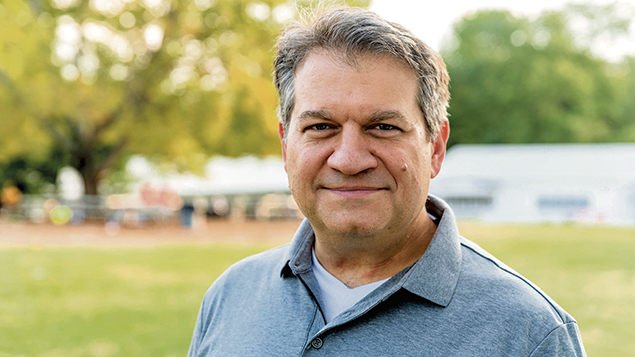
“Being an old-time camp traditionalist, I want kids to just talk to each other, to be outside, to be discovering. To make friends — not online friends but friends they have actual personal interactions with. To be in an environment where there are adults ready to care for them and talk to them 24/7. And to learn independence, having to make choices and experience things they don’t get to experience otherwise. It’s so very important.”
In its first year, he co-directed Camp Nesher with Marty Maskowitz, then assistant director of the Sephardic Community Center in Brooklyn, because the camp was formed as a partnership with that center. However, the partnership lasted only one year. After that, Mr. Braverman was Nesher’s sole director until he passed the baton to associate director Johnny Shlagbaum.
He said that the camp experience has remained basically unchanged over the decades, though here have been a few tweaks. For example, while classic activities such as color war, talent show, NFL Day, swim instruction, campfires, and singalongs are still part of the program, electives such as 3D printing were added to the mix. And Nesher campers have more freedom of choice these days to decide which activities they prefer to do.
When Mr. Braverman announced last summer that he was stepping down, many former campers and staffers contacted him to share “how much camp played a part in their wanting to become Jewish leaders in their communities and in their ability to navigate their lives,” he said. “They recalled things they learned at camp from me or from the wood shop instructor or the nature specialist or another counselor. Some of the kids sent me deep apologies for being a pain in the tuches and thanking me for taking them when no one else would.”
He chuckled as he admitted that he was one of those pains in the tuches himself. “I was not the easiest kid,” he said. “I saw one of my former high school teachers when I was an adult, and she asked me what I did. When I told her I was a camp director, she said, ‘Wait, YOU’RE taking care of children? That’s great. That’s justice.’”
He also made the courageous decision to take in children with disabilities before other mainstream Orthodox summer camps were doing so.
“This started in Year Two, when we accepted a child named Nathaniel Cohen, who had Duchenne muscular dystrophy,” he said. “This decision wasn’t met with accolades by some of the parent body. It was a tough decision; we were trying to build our brand and were afraid how we’d be labeled. But Nathaniel’s mom was so passionate about this that I went to Eugene Bell, NJY’s assistant executive director at the time, and asked him what we should do. He said, ‘Jeff, are we going to serve Jewish kids or are we not?’
“So we built a bunk with a ramp and an accessible toilet and shower for Nathaniel. That paved the way. Three years later, we started working with Yachad-National Jewish Council for Disabilities, which is part of the OU,” that is, the Orthodox Union.
“We had two bunks — one for boys, one for girls — of children with developmental disabilities. Now there are Yachad summer programs at many other camps, but back then it was groundbreaking, especially for a small camp like ours. Not everyone was happy about it. Some parents even withdrew their children, and that was scary. But I felt in my gut and heart that it was the right thing to do.”
In 2003, the National Jewish Council for Disabilities gave Mr. Braverman its Community Leadership Award for his role in developing Yachad B’Nesher.
The camp always brings a contingent of staffers from Israel.
“Our camp is extremely Zionistic,” Mr. Braverman said. “We raise the Israeli and American flags and sing ‘Hatikvah’ and say the Pledge of Allegiance every day. Many of our American staff, a lot of them former campers, take a gap year in Israel to go to yeshivas or seminaries after high school. Israel plays an important role in our camp.
“Our non-Jewish support staff from other countries, who don’t know much about Jewish people or Israel other than what they’ve seen in the news, learn a lot at camp and go back to their countries as de facto ambassadors,” he added. “They see BDS protests and they can say, ‘What you think about Israel just isn’t true.’ After October 7, I got texts of support from a lot of them, in countries such as New Zealand, Australia, England, and Mexico.”
Mr. Braverman’s three children all are in Israel now. Jordana, 30, lives in Tel Aviv; Melissa, 27, lives in Jerusalem with her husband, Michael Finkel, a former Nesher camper from Teaneck (“She didn’t meet him at camp; she met him in Israel,” her father says); and Jonah, 25, lives in Jerusalem with his wife, Gabrielle Green from Teaneck.
“My children say Nesher is their fourth sibling,” Mr. Braverman said.
In keeping with that analogy, he mused, “I let them fly on their own and now it’s time for the Nesher — the eagle — to fly without me. But it doesn’t mean I will leave it or it will leave me. Camp Nesher is always a part of me, and I’ll always be connected to the amazing young leadership of the camp and be here for them when they need me. Johnny was my assistant for nine years and is taking over with a staff of terrific people.”
He was 28 when he became director of the camp, and now he simply felt the time had come to move on. “Stepping down was a hard decision in my heart but not in my brain,” he said. “My mission as director has come to an end, but my mission in life is not over. I’m looking for my next great adventure.”
Although Camp Nesher took up much of Mr. Braverman’s time and attention, it was never his only professional pursuit.
He hosts a Passover program in Fort Lauderdale each spring and has been a chazzan for the High Holidays at a synagogue in Buffalo, N.Y., since he was 15 years old. He has recorded four albums of original Jewish music, one solo and three, as half of the Shoresh duo, with Jonathan Rimberg. For more than 30 years, he has graced countless simcha bandstands as a singer and band leader of the Nafshenu Orchestra.
Last year, he and Mr. Rimberg began offering The Simcha Package, a group vendor initiative intended to lower the cost of Jewish affairs and make it easier for families of brides and grooms to split expenses. “I’ve been involved in bands and music forever, and in weddings since 1992 as part of various orchestras. The Simcha Package speaks to my mission to help people have something nice but more affordable,” Mr. Braverman said.
A member of Congregation Rinat Yisrael since he moved to Teaneck from West Orange about nine years ago, he is and always has been active in the Jewish community, in both Essex and Bergen counties. He moved to West Orange after he graduated from Queens College in 1994; eventually he sat on the board of the Joseph Kushner Hebrew Academy in Livingston and was president of Congregation Ahawas Achim B’nai Jacob and David in West Orange. He is now a board member at Yeshivat Noam in Paramus.
Mr. Braverman pointed out that his successor, Johnny Shlagbaum, had been a camper and later a staff member who met his wife, Alana, at Camp Nesher before returning years later as assistant director. Mr. Shlagbaum also lives in Teaneck.
“Working with Jeff has truly been a gift,” Mr. Shlagbaum said. “To sit day in and day out beside a visionary like no other in the Jewish camping world is something I never take for granted. There is so much that happens behind the scenes — the countless moments where Jeff goes that extra mile to make every camper and family feel supported — and those moments define who he is as a leader.”
Mr. Shlagbaum noted that Camp Nesher was built on the foundations of hakarat hatov, a Hebrew term for appreciating goodness, and bein adam l’chavero, human relationships.
“That spirit remains its heartbeat,” he said. “As we look toward the future, our mission is to preserve that neshama — the soul of Nesher, while continuing to build its body, enhancing and beautifying our campus so that it remains the most inclusive, welcoming home it can be for generations to come.”
For information on the November 22 gala, go to www.campnesher.org/nesher30, email debra@njycamps.org, or call (973 )575-3333, ext. 184.