

Perfectly imperfect
Learning to bake challah is learning to connect, create, hope, and pray
The knife had just broken the crust of my homemade challah at a recent Shabbat meal when a friend leaned over and asked how I had learned to bake it.
Learning to bake challah had been on my bucket list for years. I talked about it often and asked friends for recipes, but the task always felt too daunting to attempt. My excuse was simple: I never seemed to find the time.
I often asked myself, “Can this grandmother learn new tricks?”
Then the covid pandemic hit in 2020, and we were forced into our homes for months. Suddenly, time — something we always claimed to lack — was abundant. As we isolated ourselves from the world, people coped by taking up new hobbies and learning to be resourceful. Some redecorated their homes, others rescued pets from shelters, and many of us learned how to navigate Zoom so we could continue working and meeting virtually.
As a teacher, I had no choice but to learn Zoom quickly when it became clear that schools — even yeshivot — would not be opening anytime soon.
It felt like now or never.
I reached out to Debbie, the challah maven in my Teaneck community. She offered me what she called a foolproof and easy recipe. Those words had a special ring, and the recipe at first glance seemed very doable.
Debbie treats challah dough as an artist or sculptor would, braiding perfectly shaped strands into a variety of beautiful forms. She also leads challah demonstrations where people gather to learn each step and connect in a fun and meaningful way.
Debbie is deeply passionate about sharing her knowledge of this important mitzvah. Not only did she give me the recipe and a special large bowl in which to mix all the challah ingredients, but she also shared her thoughts about the spiritual significance of baking challah.
In Jewish thought, preparing challah is a way of welcoming holiness into the home. Baking challah reflects the idea that spirituality is found in prayer — and also in everyday actions, through food and sustenance.
Before pouring the flour and other ingredients into the large green bowl Debbie had given me, I did a major self-check. I decided that my first attempt didn’t need to be perfect. The challah just had to be good enough to grace my Shabbat table.
The recipe called for five pounds of flour, yielding several challahs that I could freeze for the coming weeks. Over the course of a few hours, I followed the instructions step by step. Watching the dough rise felt like a small miracle, and I imagined my ancestors in Europe long ago, baking their own challah in preparation for Shabbat. When the dough had fully risen, I performed hafrashat challah, separating a piece of dough and reciting a bracha, infusing the experience with spirituality.
In the Torah’s book of Bamidbar, it says, “From the first of your dough you shall set aside a portion.” Although there is no longer a Kohen Gadol — a high priest — or a Beit HaMikdash — the holy temple — we continue to fulfill the mitzvah by separating the challah and disposing of it.
It is also a moment when we reflect and add personal prayers — for the well-being of others, for peace, and for good health. This part of the challah baking process feels especially meaningful, when I take a portion of the risen dough and pray for the recovery of some of my relatives, close friends, and acquaintances by reciting their names.
When that first Shabbat arrived, my challah made its debut. It tasted fresh and delicious, though the shape was somewhat lopsided and imperfect. Still, the sense of satisfaction I felt was immense. With each batch, I tried to improve — tweaking ingredients, experimenting with recipes, and adding different toppings. The challah wasn’t always perfect, but it was always good enough.
Over time, I realized that my challah journey is a metaphor for life itself. Situations are rarely perfect; they can be messy, uneven, and bent out of shape. Yet they can still be meaningful and fulfilling. Perfection, I’ve learned, is overrated.
I’ve baked during some tough personal times. Somehow the entire process reminds me that even when life feels unsettled and difficult, something good can still take shape. Somehow the entire process is a form of tefillah — prayer — and of self-help, steadying my spirit and giving me hope.
And we are not alone. If you’re looking for support, there’s an entire online challah-baking community, including “Challah Baking for Dummies.” People from all walks of life share recipes, ask questions, exchange tips on braiding styles, and post short videos. I’ve even seen posts from men who love baking challah.
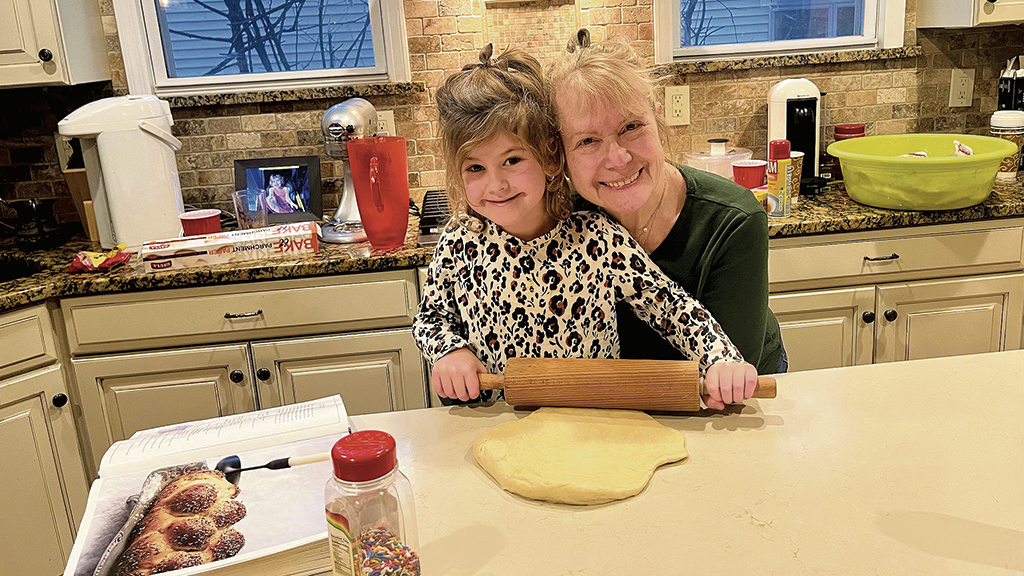
A few weeks ago, my granddaughter came over for the afternoon, and she was excited to bake challah with me. We measured, poured, and rolled the dough together. I did the braiding, and she rolled her dough into small challahs, topping them with colorful sprinkles. We made a fun mess together with all the different ingredients. It was an afternoon filled with connection and meaning.
My challah-baking journey remains perfectly imperfect — and that’s just fine with me.
Esther Kook of Teaneck is a reading specialist and a freelance writer. Her work has appeared in Jewish Action magazine and Hadassah magazine.