

Public schools, Jewish values
OU’s Student Union carries the message into secular settings
Leila Kravitz, a 17-year-old Bergen Tech senior from Bergenfield, started a Jewish Student Union chapter last year with classmates Ariela Geckman and Selah Kessler to serve the Teterboro-based high school’s small Jewish population.
JSU, a project of the Orthodox Union’s NCSY youth movement, encompasses about 515 student-led clubs across North American public and secular private high schools. Its goal is to provide a fun, educational, and inspiring environment in which to foster friendships, Jewish pride, and a connection with Judaism and Israel.
Every Tuesday at 3 o’clock, New Jersey JSU coordinator Ben Kron arrives at Bergen Tech with pizza for approximately 20 kids — including a few non-Jewish students — who come to enjoy an hour of activities such as games, projects, or discussions planned by the student leadership in coordination with Mr. Kron. Sometimes there are JSU social and recreational events outside school, too.
“I heard about JSU during my junior year through a friend at Bergen Tech whose brother at a different school was the national president, and with the rise of antisemitism in school, we decided to start our own,” Leila said.
“The main purpose is just to have a sense of community and a safe space for Jewish teens. It has also helped me connect to my Judaism more and take initiative; I am now co-president of the club and l am on JSU’s New Jersey regional board and international executive board.”
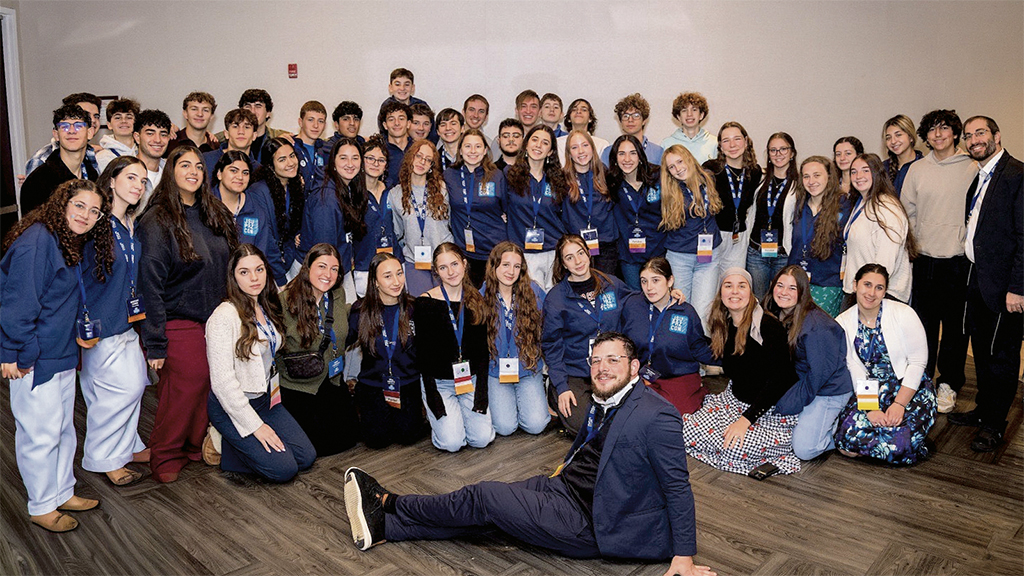
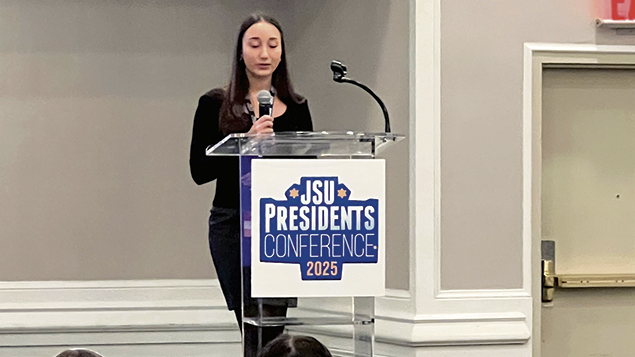
Leila was one of more than 300 JSU teen leaders from across North America who gathered for the annual JSU Presidents Conference on November 9-11. The intensive three-day leadership summit, held in Stamford, Connecticut, drew about 50 participants from New Jersey, including Bergen-Hudson and MetroWest.
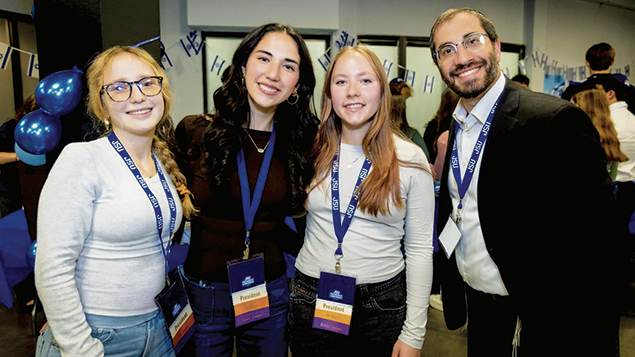
“Last year I attended my first ‘PrezCon’ just a few weeks after we’d started the club,” Leila said. “It really exposed me to how big the JSU community is.
“You meet people from all over North America, and you gain leadership skills like how to lead the club and how to spark attendance and ongoing interest in the club, as well as how to have effective, respectful conversations with people who don’t agree with you.” This latter skill, she said, is useful for themselves and as a tool they can impart to JSU members to employ when involved in sometimes emotionally charged Israel-related or Jewish-related conversations with peers.
At this year’s conference, which she helped plan, Leila said there were lively discussions about programming, about how best to publicize the club’s meetings, and about attracting and keeping new members.
Leila, a student in Bergen Tech’s fashion track, said the main key is offering engaging and worthwhile activities and staying in touch with club members between meetings. “They see how special it is, and then they stay,” she said.
Leila observed that the conference workshops were “designed to inspire students to take initiative, lead with courage, and practice everyday mitzvot. I saw the impact firsthand when my assigned partner and I created a workshop focused on giving tzedakah. In just 15 minutes, groups of passionate and dedicated teens selected a Jewish charity of their choice and then advocated for it in front of the rest of the group, explaining why it was an important cause.
“Seeing my peers so passionate to give back, and being driven by Jewish values, is a memorable feeling and encourages us to connect with our Judaism in daily life.”
An unexpected highlight, she added, “was when we all spontaneously gathered around a piano in the lobby and began singing ‘One Day’ together, singing for peace and an end to hate. It was an emotional moment that brought the entire conference together in a shared hope.”
Rabbi Reuven Lebovitz of Fair Lawn, director of JSU for New Jersey, Connecticut, and upstate New York, said the JSU Presidents Conference started in 2021 to bring together JSU student leaders from across North America. The first conference had about 80 participants; this year’s conference attracted more than 300.
“It’s an opportunity to get leaders together for 72 hours and meet other leaders and share problems and solutions,” he said. “It’s been tremendous. It’s a mix of fun — like a 5K run to bond participants — and lectures and skill-building activities. We bring speakers from Israel advocacy groups, for example. Through it all, the students build connections and work together to gain practical takeaways they can use day-to-day as JSU leaders.”
Rabbi Lebovitz said that before the October 7 attacks, JSU had 17 clubs in the MetroWest, Bergen-Hudson, and Central-Southern regions; since then, demand has skyrocketed and “we are about to open our 39th club in New Jersey.” There are 16 JSUs in Bergen-Hudson and nine in MetroWest.
“After October 7, a lot of public-school kids felt very isolated and were asking us to open JSUs at their schools,” he said. “We didn’t really have the funding to open these clubs, but kids were knocking on our doors asking for a Jewish experience, so we did it and found the money afterward.”
“Some clubs meet weekly, others biweekly or monthly,” the rabbi explained. “Each school provides space and a club advisor, and we send our staff to facilitate the meetings, which are run by student leaders. In each location, we listen to what the students want when planning programming.”
Regional JSU clubs sometimes participate in joint activities, such as Shabbatons or ice skating, as well as larger events for JSUs from across the state. Students also have the opportunity to go to Israel in the summer on an NCSY group tour designed for public school teens. “We are creating Jewish connections and experiences that broaden their community,” Rabbi Lebovitz said.
“We’re a space for them to get together and celebrate their culture and values.”