

Remembering and letting in some light
Singer, storyteller, and Oct. 7 survivor Micha Biton will perform in Hoboken

And who by fire, who by water
Who in the sunshine, who in the night time
Who by high ordeal, who by common trial
Who in your merry merry month of May
Who by very slow decay
And who shall I say is calling?
—Leonard Cohen
Yes, Leonard Cohen’s “Who by Fire” is unmistakably a version of Unetaneh Tokef, the High Holy Day list of the many terrible ways to die, along with the assertion that prayer, repentance, and charity can spare us from them. Cohen wrote the song in 1973, after he’d performed for Israeli soldiers during the Yom Kippur War.
So why use those words to introduce a story about Micha Biton, the Israeli whose long career as a singer, songwriter, and storyteller — he calls his genre “ethnic rock,” described as “combining Western rock music with Moroccan inspired scales and instrumentation”— and his astounding survival of October 7, along with his nuclear family, have given him the impetus to compose new songs? Songs, moreover, that he will perform at the United Synagogue of Hoboken on Sunday, October 12, just before Simchat Torah and the second anniversary of October 7 on the Jewish calendar.
Because the way Jewish history weaves themes and events and emotions and fear and hope so tightly together that they are inextricably bound means that Micha Biton’s life and work and message inescapably point backward and forward, like the two-faced Roman god Janus but in our tradition, and with much more depth. (And because both Leonard Cohen and Bob Dylan influenced him greatly, he has said.)
Okay. So who is Micha Biton? What’s his story?
Mr. Biton was born in Sderot in southern Israel, in 1965, one of 10 children; their parents, Amram and Perla, were born in Morocco. He always seemed to be full of music, he said; his father recognized that and had him sing on stage for the first time when he was 5 years old.
When Mr. Biton was 9, his father died suddenly. That would be traumatic for any child; it upended little Micha’s life. He was sent to Jerusalem, where he became one of 10 foster children of the well-known, well-respected Israeli writer Galila Ron-Feder Amit, joining the three children to whom she’d given birth. Later, he went to a public boarding school. All of this gave him a background from which he could — and does — draw.
In 1990, then a self-proclaimed pub singer, he found himself looking to rent a room in Moshav Netiv Ha’asara, close to the border with Gaza, near Sdorot. He met Na’ama, they married, and he ended up profoundly at home there. Micha and Na’ama Biton have four children and now they have four grandchildren. His career flourished. He co-founded a band, Tanara, which became successful but resisted the siren call of Tel Aviv and instead remained in the south. He came to realize the importance of community and established a pub and a cultural center. He was doing well and he was happy.
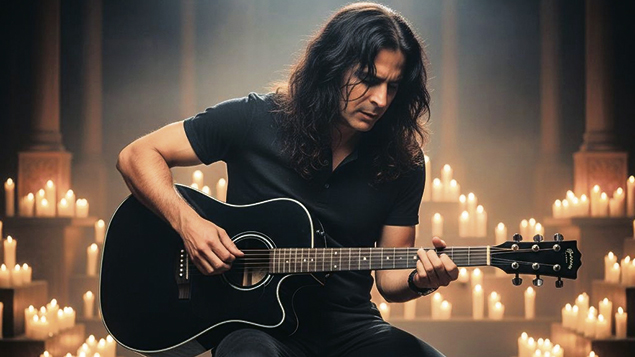
On October 6, 2023, erev Simchat Torah, the whole family — kids, grandkids, Na’ama’s parents — celebrated together, and everyone except Na’ama’s parents slept over. At 6:30 the next morning, the nightmare began. First it was the sirens. The family went to the bomb shelter — the youngest son’s bedroom. That wasn’t entirely unusual — Gaza is just next door. But then it didn’t stop. And then they started getting texts. Friends had been murdered. Friend after friend after friend. Texts from friends pleading for help came in, followed by news that those friends had been slaughtered. Twenty members of the moshav were killed, including their next-door neighbors.
Somehow, inexplicably, the murderers didn’t come for the Bitons.
Eventually, the safe room became unsafe because all the people in it had sucked out all the air. Breathing was becoming difficult. So, Mr. Biton told the Times of Israel last year, “we had to decide if we would suffocate to death or open the door to let some air in. I went out of the shelter, took a hammer, stood in the living room, and waited.
“I planned strategies. I hoped that if something were to happen, I could save my family. I was on full alert and prepared to sacrifice myself.”
Nothing happened. For some inexplicable reason, the assassins skipped their house. The Bitons and everyone else left alive on the moshav evacuated to Tel Aviv, where they stayed for some time.
“It was like the Holocaust,” Mr. Biton told me. “It was so terrible. We thought that this was the end of all of us. The end of us personally. The end of our family. The end of our country.
“But after a couple of days, we said, okay, we must be strong. We must try to look to the future.”
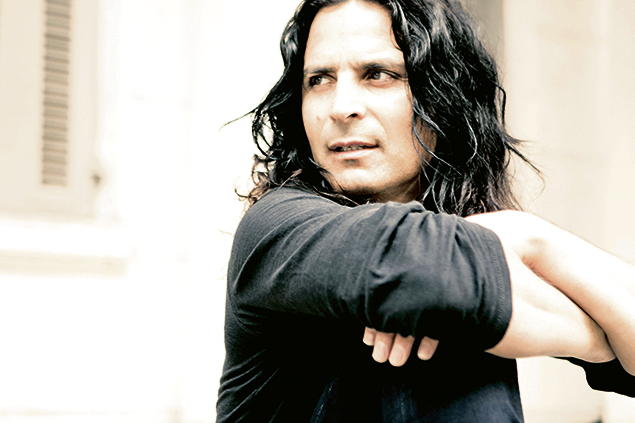
First, though, the survivors had to get through the funerals.
“It took about three weeks,” Mr. Biton said. “We buried so many friends. And the funerals didn’t end. They always found another body, and another one, and another one. And of course there are the hostages, who we care about. Some were released alive, some were released dead, and some have not been released yet.
“It is never ending.”
Mr. Biton’s initial response to October 7 was selective mutism. He could talk to his immediate family, but he could not make himself speak in any other setting. The words could not come out. “I was so sad about what I had lost. About what I could have lost. About our neighbors and friends and family who were killed. I couldn’t talk. I just cried.
And even after he could talk, he could not sing.
And then, “one day, a radio host asked me to go on her show, and I did. She asked me to sing, and I said no. I said I can’t sing. And she said, ‘Please try. Please try to play something.’
“So I said okay, and I took the guitar, and I started to cry. And then I figured out that this is my way to heal myself. And it isn’t only for me. It is for my audience. They are waiting for me to get back to the stage. And then we can grieve together and pray together, and we pray for the hostages because we want them to come back home.”
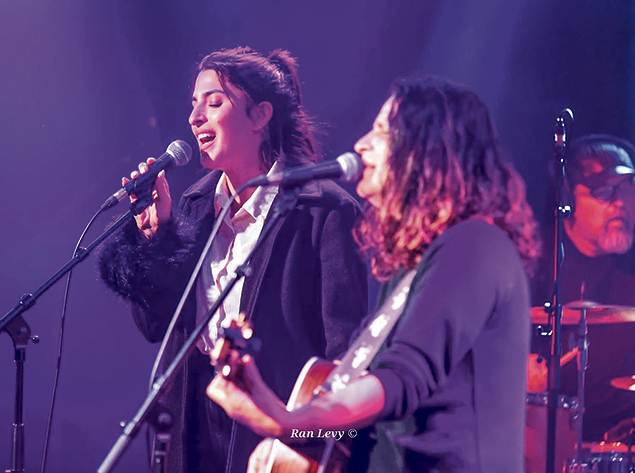
Now, Mr. Biton’s been touring all over, and his schedule has become particularly intense, as synagogues and other Jewish institutions want to commemorate October 7.
It makes sense for Mr. Biton to lead that commemoration with his performance.
“Now, more than ever, it’s very important to me to tell our story, because sometimes I feel that people are forgetting October 7,” he said. “I know that now American Jews, and Jews all around the world, are concerned about antisemitism, which is really rising. It is all over the place, and it is terrible.
“Sometimes no one wants to see the truth, because a lie can be more sexy. Sometimes I feel that people like to believe the lies more than the truth — and the simple truth is that we want peace.”
“Although he has strong feelings about politics, “when I perform, I concentrate only on my personal story. I don’t talk about politics, and I don’t talk about solutions. I talk about what happened to my family on that terrible day, what happened on October 7, and how we survived.
“I always finish with a prayer for peace, and that the hostages will be back home and the war will stop. This is what I say in my concerts all over the United States, and all over the world. This is my message for the world — that there must be something new in Gaza, in Israel and all the world. I hope that all the world will come together and we will stop the terrorism.
“The world needs to wake up and see how this terror is the worst thing that can happen.”
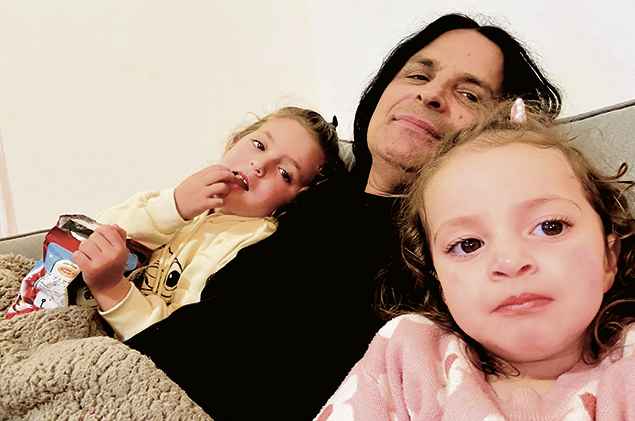
Some of the songs that Mr. Biton is performing now are new ones, written after October 7; others are not. Even before that day, “I wrote that I am always looking for a light, even when it is dark. That’s a good message for me, and for the audience. Even if you can’t see the light, you always need to look for it.
“I finish the show with a lot of optimism, because there is no other way to be. We must be strong. We must pray for peace. Things must change. I think about the First World War, and the Second World War, and how after so many things were destroyed, they were rebuilt. Something new is always rising, and it is always different.”
Rabbi Robert Scheinberg is hosting Mr. Biton’s concert. He explained how he decided to do that.
“We were trying to figure out the appropriate way to mark October 7,” he said. “There are so many conflicting emotions. And the timing is harder this year than last year. We knew we couldn’t do it on October 7, because that is Sukkot.” (This year, the holiday starts the evening of October 6, so October 7 is its first full day.) “And on the Jewish calendar, the anniversary is always going to be Simchat Torah.
“We decided that we wanted to do something that would be in memory of October 7, but also something that would give the community hope and solidarity. So we decided to do it as a musical event.”
“We know that there are so many connections to Israel in our community, and we know that we want to do something in Hudson County, and we probably want it to be different. We want something that would both give people the opportunity to gather to remember something terrible, and also to reinforce the message of hope and resilience.
“And there has been such an outpouring of artistic responses to October 7 — with poetry and music and visual artwork — that we wanted to foreground an artistic response.”
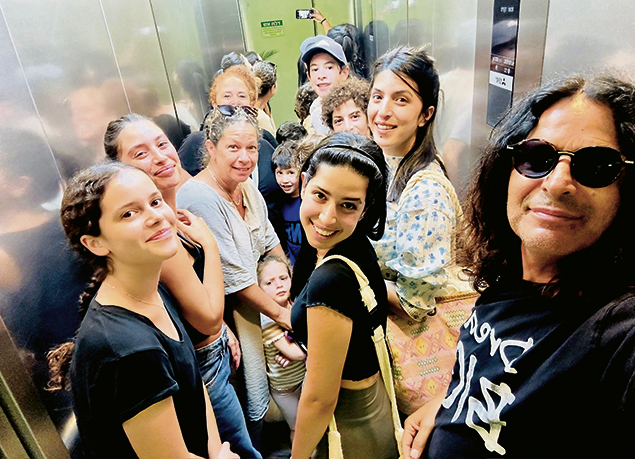
There is one element of Mr. Biton’s performance that has nothing at all to do with art or trauma, but Rabbi Scheinberg wants to highlight it nonetheless. It is that although it is notoriously nearly impossible to find parking in Hoboken — even the garages seem to be unmarked, and you might as easily find a gold bar on the sidewalk as free legal parking next to it — his shul has come to an arrangement with the city. Now a garage just a few blocks away offers free parking to people going to programs at United Synagogue. The garage will give the parker a ticket, which someone at the synagogue will validate. The information is on the shul’s website, hobokensynagogue.org.
Rabbi Scheinberg returned to the issue of how to mark October 7 on Simchat Torah; even if the calendar didn’t demand that it be acknowledged then, on its Jewish anniversary, the memories of that day are hard to dislodge. (And shouldn’t be dislodged. Like so many grim parts of our history, it’s part of our history now.)
Last year, Rabbi Scheinberg created a suggested ritual hakafah — one of the seven circles that we make with the Torah during Simchat Torah services. It was published by his rabbinic organization, the Conservative movement’s Rabbinical Assembly. In it, Rabbi Scheinberg suggested that in the middle of the middle hakafah, the fourth one, the congregation should stop dancing, sit on the floor and recite verses or sing songs of lamentation. Then they should get up and resume dancing.
That’s based on the example of the Jewish community centuries ago, which responded to a massacre inside a shul on Simchat Torah in exactly that way.
“Like most Jewish communities, we think about October 7 all the time,” Rabbi Scheinberg said. “We include the prayer for hostages in our services at least once every day. We don’t know what a memorial day for October 7 will be like going forward. We know that it is going to cast a long shadow on Rosh Hashanah and Yom Kippur.”
It’s not yet clear exactly how the Jewish world will mark October 7, and the stain on Simchat Torah, in the coming years, he said, but it is clear that however we do it, it will change. “It took a long time for the commemoration of Yom HaShoah and Yom HaZikaron to take shape, and it will take a long time for this commemoration to take shape. Probably it will take different shapes in different communities, and probably it will change over time.”
For now, at any rate, the shape it will take, at least in Hudson County, is a performance by a survivor who also is a gifted and popular musician, and who will look backward with horror and forward with hope. If things work as planned, that will provide some hope for all of us.
And as Mr. Biton said, “we pray for the hostages, and we want them to come back home.”
Who: The United Synagogue of Hoboken
What: Presents Micha Biton in concert to mark October 7
When: On Sunday, October 12, at 3 p.m.
Where: At the shul
How much: $20 per ticket before September 28, $25 after; $60 per patron ticket
And also: Parking is free! And available!
For tickets and more information: www.hobokensynagogue.org; for parking information, go to www.hobokensynagogue.org/parkingush