

Resetting the table
Glen Rock shul works on deeply listening to each other
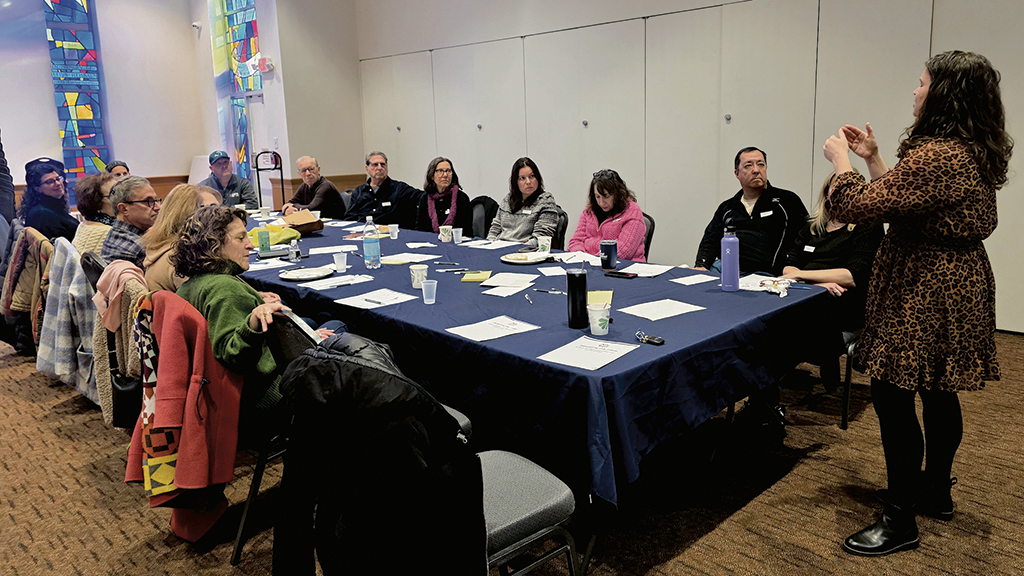
It is breaking no news to say that we are living in divisive times.
Synagogue communities are not immune from the politicization that infects other groups, the divisiveness that changes what should be comfortable, loving havens into places where you have to watch what you say and who you say it to.
“I am probably not alone in being a leader of a community where people don’t agree on everything, both with regard to American politics and Israel,” Rabbi Jennifer Schlosberg, who heads the Glen Rock Jewish Center, said. “After October 7, different members of my community were sharing different feelings about the war.
“It has always been a priority for me to say that regardless of your thoughts, you are still a community member here, and I still care for you, and you have a place here,” she continued. “It always has been important to build a community where we can disagree, but still, at the end of a day, at a simcha or at a shiva call, we prioritize being a community of people who care for each other.”
But as the world becomes more on edge, as differences become more stark, “I meet with people on both sides of the political spectrum who have said that they feel like they’re in a minority.”
Also, she said, “What many of my colleagues and I sometimes feel is that we are leading communities where people sometimes want the reassurance that their rabbi feels a certain way about a certain issue, and if that doesn’t align with what that person feels, then it isn’t the right place for them. They feel that they don’t belong.”
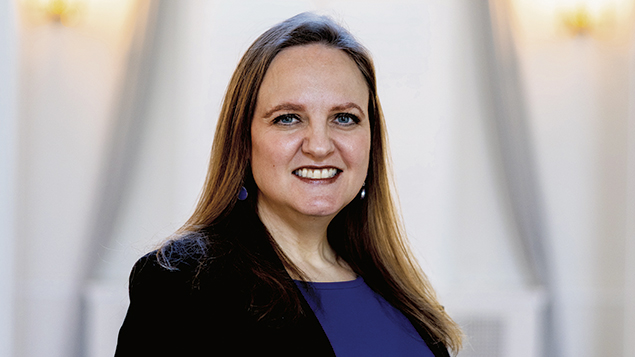
The problem is widespread, she said. “We are living in a cancel-culture world, where the moment we hear someone say something or do something that is counter to what we believe, instead of inviting a conversation with curiosity, instead of saying, ‘Oh, I don’t see it that way, but please tell me why it’s so important to you,’ we just feel that we don’t belong.”
“This is not just my shul,” she said. “This is everywhere.”
So when Maggie Jacoby, who lives locally and is working on a fellowship for a group called Resetting the Table, suggested a program that helps people to learn to listen to each other, “I pursued it,” Rabbi Schlosberg said. “And I want to celebrate the fact that we are trying to address this problem head-on.
Resetting the Table, as its website, resettingthetable.org, shows, “bring[s] decades of conflict expertise to an ambitious vision: to build a cohesive, resilient society in the U.S.”
The training focuses on “how to facilitate difficult conversations with a community of people who don’t always agree,” Rabbi Schlosberg said.
It’s a deeply Jewish approach, she added. “We, the Jewish people, have always appreciated dialogue, and we celebrate that if it is a machloket — a disagreement for the sake of heaven — we can learn from the other person. I think that we lost the sense of holiness when we stepped away from that tradition, but now, instead of welcoming a conversation, often we back away or issue a litmus test.
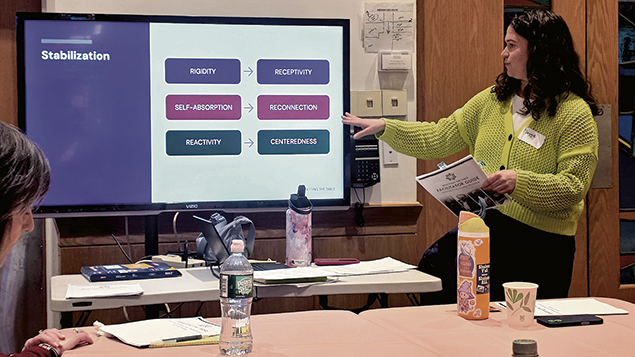
“So when Maggie, who is a conflict management professional, reached out to us, it felt like it was bashert.
“We ended up having two sessions. Almost all of our staff, some of our executive board members, and some lay leaders — about 14 people — attended the first session. We learned what works for us from that, made some minor tweaks, and then had a second session, for the community.”
The first session, held during the day, was in November; the second, on a recent Sunday, lasted for three hours and included brunch. Participants registered in advance, so they were sent surveys that asked about whether they avoided discussing hard questions with family members or colleagues and about their views on such issues as Israel.
“That survey served two purposes,” Rabbi Schlosberg said. “It showed us where the group’s members were aligned, and it also showed us how to group people who have different views in some areas so we could use it as a laboratory to practice how to listen.
“The goal is to reflect back what we’ve heard in a way that shows that we really heard. It’s to show that we know the music behind the words.
“That is the ultimate goal. Once we could demonstrate that we heard someone else, they could feel heard and understood, the likelihood of them doing it for us is significant. It gave us the opportunity to practice those skills with other people who also were trying to practice those skills.”
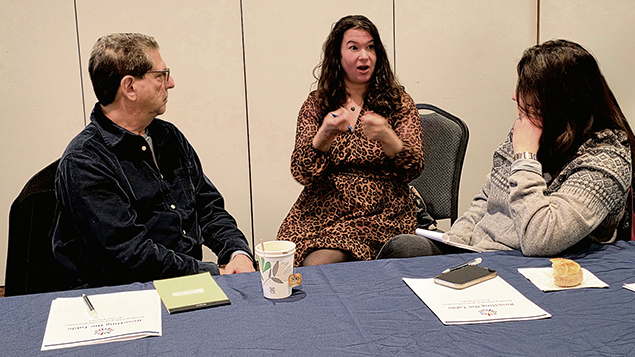
The larger group, of about 18 people, was broken into pairs or triads, and began by each person describing “an experience in our lives that shaped or informed our current beliefs,” Rabbi Schlosberg said. For example, “if someone in our household was disabled, that would have affected us and impacted how we feel about healthcare.” This not only helped give context to deeply held beliefs but “also enabled community members to get to know each other.
“One of the holiest parts of the session was that people shared some very deep, intimate stories, some from their childhoods. Beliefs don’t come from a vacuum. They are influenced by our life experiences.”
The participants ranged widely in age; the staff meeting included people in their 30s through their 70s, and the congregational session’s participants were from their 40s to their 80s, Rabbi Schlosberg estimated. That ranged added to the depth of the conversations.
Now what?
“I hope to use some of what we learned by sharing it with the broader community,” Rabbi Schlosberg said. “I just sent out an email saying that you might feel alone, but probably you are not. There probably are people who feel what you are feeling.” She added that the meswsage isn’t only for people whose views are on either end of the spectrum, but applies to people “in the middle of the road.”
She hopes “to spread the word about what we learned, so we can model it in meetings, in difficult conversations, and in making decisions. I hope to model it” — the idea of talking about differences, and listening to each other during those discussions — “instead of expecting that we all will agree.” The staff meeting was just before Thanksgiving, and some participants were able to use what they learned at what otherwise could have been an awkward or stilted family gathering.
“One of the questions the facilitator asked us was who would be proud of us for attending this session,” Rabbi Schlosberg said. “A lot of people said a child or a parent, either because they agree or they disagree. This drove home the idea that this” — the feeling of discomfort with expressing any disagreement — “is happening even in the privacy of our own homes, with our own families. The skills we learned are applicable not only in organizational settings, but in our own homes.”