

Teaching Torah to kids
Hadar Institute comes out with book of Bible stories aimed at little ones
What does a child make of Bible stories?
To look at them with fresh eyes — that is, with a child’s eyes, uninformed or unburdened by the accretions of understanding or misunderstanding or historical context through which those of us who no longer are children filter them — is to be puzzled.
What do they mean? Who are those people, and why are they doing those things?
Hadar Institute, the intellectually and spiritually intense traditional egalitarian organization that works to provide learning and model practice to enhance Jewish community and life, includes a publishing group called Hadar Press. Hadar Press has put out the first of what will be all five books of the Torah.
It’s started not quite at the beginning, with Bereishit, but with Shemot — Exodus — the second book of the Torah, which “is the story of how the Jews became a nation,” Rabbi Effy Unterman of Teaneck said.
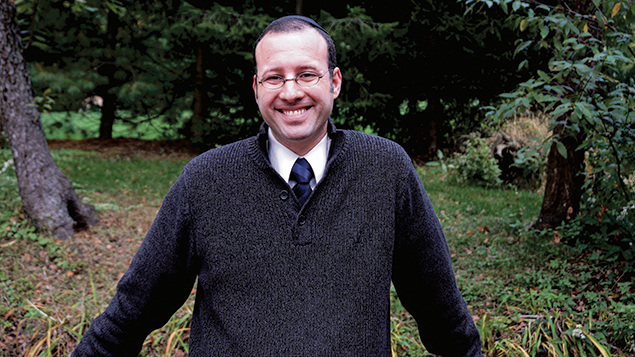
Rabbi Unterman is Hadar’s senior director of content. He explained how the Devash series grew out of the magazine about the weekly parsha — that week’s Torah reading — that Davar has published both online and in hard copy for the last four years.
The magazine, also called Devash — that’s Hebrew for honey, because Torah learning is sweet, and the association between honey and Torah is old — is illustrated and aimed at “just about everybody, as long as you can read.” It’s aimed at children as young as 7 or 8 and at their parents too; “some content is more sophisticated and some is less so,” Rabbi Unterman said. It includes the Torah text, in English and in Hebrew, some commentary, again in both English and Hebrew (or Aramaic), and some questions.
The first three years held new commentary and questions for each parshah; now those first three years are being updated where necessary and then rerun. “The first group of kids has gotten older, and there are a lot of new kids,” for whom the material is brand new,” Rabbi Unterman said.
“This has allowed us to focus on books. While we continue to run the magazine, we are developing two series of books.” One is a collection of the parshiot; the other is the new Torah commentary.
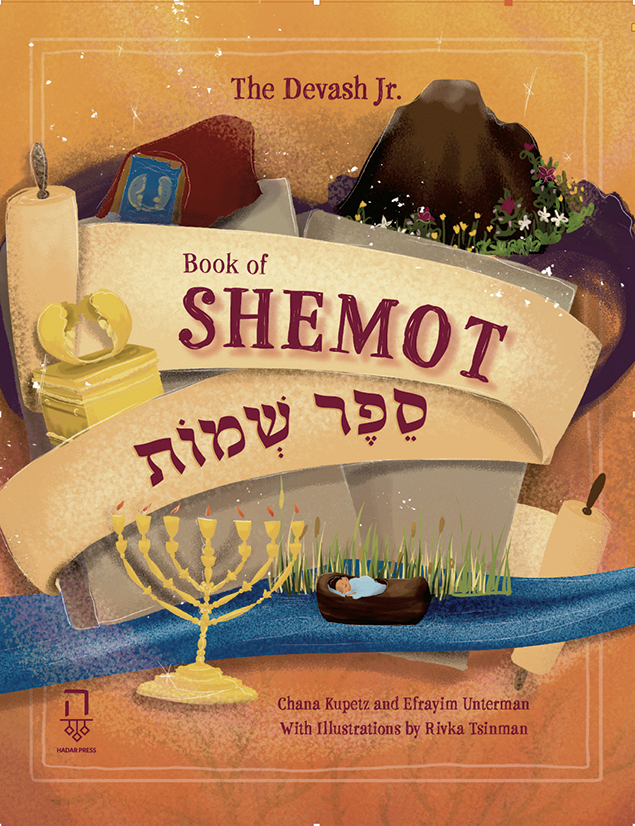
That first book is called “The Devash Jr. Book of Shemot.”
“The main age for readers will be 5,” Rabbi Unterman said. But he thinks that what he saw happening with the magazine is that parents were reading them with their children, or even without their children.
“We treat children not like future adults, but like people who can learn and study the parsha now,” he continued. “That means that we’re providing real sources — real biblical tests, real talmudic texts, real commentaries in Hebrew. It also has a scaffolding” — the heading, the explanatory words introducing a commentary that give the writer’s name and approximately how long ago he lived (children can grasp 1,000 years ago more easily than 13th century, Rabbi Unterman said, although none of it is easy to understand) — “that explains what’s going on, and it has questions.”
The questions are meant to encourage discussion.
For example, Rabbi Unterman said, take Parashat Noach, when Noah builds the ark. “There’s a midrash there saying that Noah needed encouragement to get on the ark. The midrash says that he actually was struggling with his faith. He wasn’t quite a full believer.
“So we put in the midrash, and then we asked questions like, ‘Why do you think we have a hard time believing some things, even if they’re obvious to others? Why might something be hard to believe in? What does that tell you about Noah as a person and about ourselves as human beings?
“The Torah says that Noah was a great person, and yet he also had trouble believing n something very important to him. We look up to him, even knowing that he wasn’t perfect.
“These are questions for kids and their parents to discuss, or sometimes just to think about.”
One thing that Devash does not have is a quiz. “If you know the answer, great, you’re a genius. If you don’t know it, how do you feel about yourself? And what is the point of making someone feel that?
“Our goal is that we don’t care about answers. We want them to have questions.”
That’s true for both the magazine and the books.
In the books, “The goal is to tell the story in a very clear, engaging way that is faithful to the simple, straightforward reading of the Torah text, without us creating too many things or editorializing too much. Our goal is just really to present the Torah teaching.”
So what’s on the page? “There is a passage from the parshah that has to do with the illustration and narrative on that page,” Rabbi Unterman said. “Even if the kids don’t end reading it, even if they don’t use the pesukim” — the biblical verses — instead focusing on the retold story — “even just having it here is a beautiful way to show that this is not just a story.
“This is the Torah. And this is for you too.”
Rabbi Unterman and educator Chana Kupetz wrote the “Devash Jr. Book of Shemot”; both are on Hadar’s content team, and both have had much experience working in day schools and with young children. (Rabbi Unterman, whose smicha is from Yeshiva University’s Rabbi Isaac Elchanan Theological Seminary, also was a shul rabbi for a decade, first in Columbus, Ohio, and then in East Brunswick.)
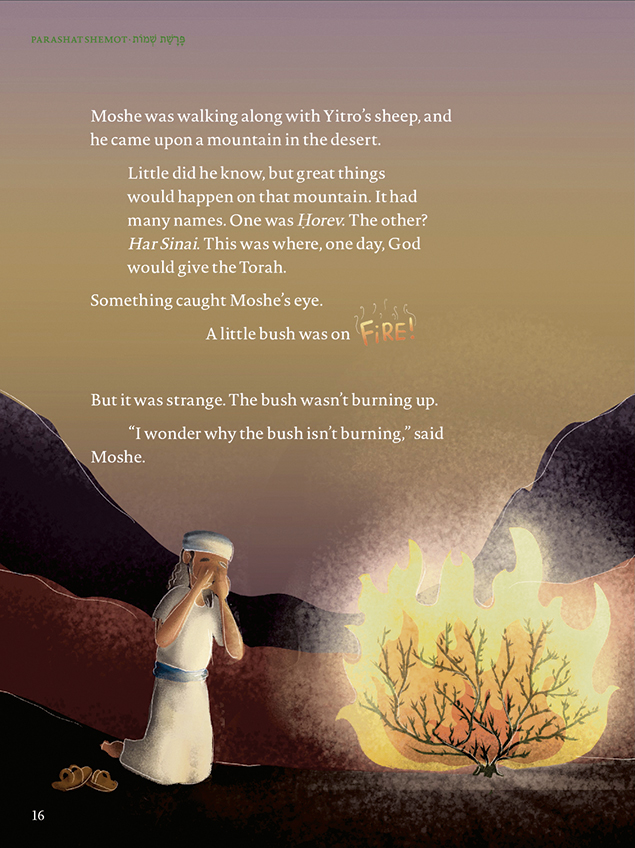
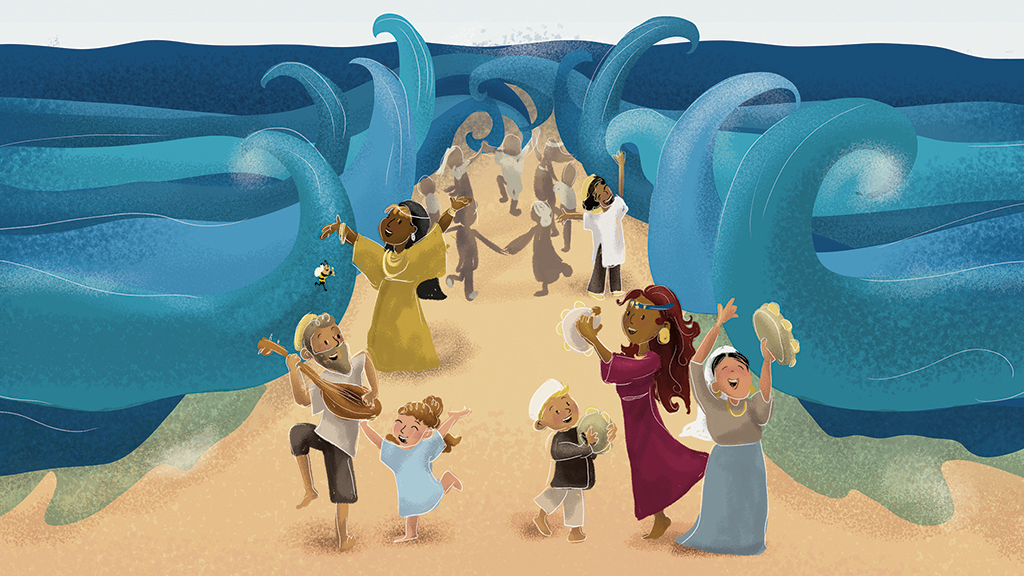
The illustrations, by Rivka Tsinman, are appealing and colorful. They’re straightforward in their storytelling. They also include girls and women whenever possible. “We want girls to see themselves in the parasha,” Rabbi Unterman said. They’re also racially diverse, and show people of many body types. “The goal is that every Jewish child sees themselves in the story.
“Inevitably, when I’m traveling and I meet local school administrators, they always tell me that if only I knew what it was like. They have just a few families of color in the schools, and it is so meaningful to them” to see themselves in the illustrations.
He knows that the children can’t read the text of the Torah portion themselves, and that even if they could read it, they wouldn’t understand it. “Even if the parents don’t read it,” even if they only look at the illustrations, “this is still a really beautiful way to show that the Bible is not just a story,” Rabbi Unterman said.
The message is that “it is taking the whole diverse Jewish community and saying: Whoever you are, whatever background you come from, this Torah is for you. It is a way to encourage and hopefully to create a lifetime of learning. It’s an added layer of activity, and learning that if kids are interested and so are their parents, it’s there for them.
“Each parsha that we leyn on Shabbat is its own chapter in ‘Devash: Shemot.’ At the end, there is an added layer of security and learning for kids who are interested, or parents who also are interested. It” — the Torah — is there for them.
“Whoever you are, whatever background you have, whatever level you’re at, however old you are, this Torah is for you. It’s a way to encourage and hopefully create a lifetime of learning.”
There are three small boxes at the end of each parsha, Rabbi Unterman said. One is a summary, the next has a few questions, and the third “is a suggestion for a really easy way for kids to enact something in the parshah to bring it to life. So if it’s about, say, the Ten Commandments, it’s about how to do something proactively to honor your parents or grandparents.”
How does Devash deal with parshiot that don’t seem inherently interesting to children? What about, say, the passages about building the mishkan, the desert sanctuary? “The first one is to ask your parents to help you donate something to a synagogue or bring clothing to a donation box or a toy drive.
“In the parasha about the priests’ clothing, the idea is to dress up fancy and think about how it feels. What is the experience like?”
Everything in a Torah story can be interesting to children, if it’s presented to them with both creativity and integrity. That’s the task that Hadar undertook with Devash the magazine, and it’s now continuing with “Devash Jr. Book of Shemot.” The plan is for the other four books to be released in the next few years.
Learn more about Hadar at hadar.org; scroll down to Books at the bottom of the homepage and click on it for information about ““Devash Jr. Book of Shemot.” The book is for sale on Amazon, and easily googleable there.