

The musical Mloteks fight the darkness
Brothers and sister record a Yiddish version of ‘Light One Candle’
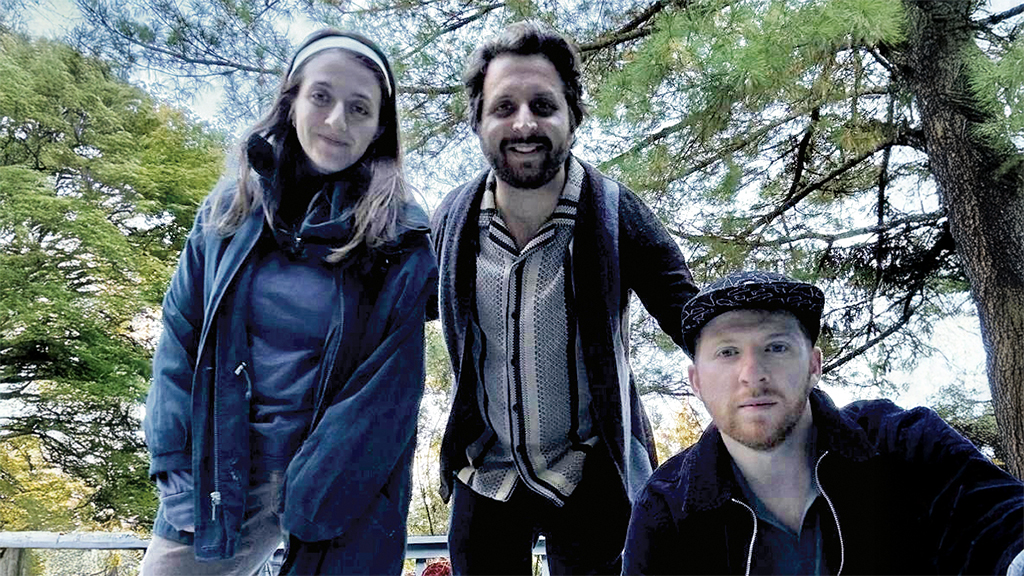
“The world can always use a little more light, no?”
That’s how Avram Mlotek introduced the new recording that he, his sister, and his brother have just released, in time for Chanukah and on the anniversary of his grandmother’s yahrzeit.
Okay. How does this release bring light?
Because the song is “Light One Candle,” the popular Chanukah song by Peter Yarrow of Peter, Paul, and Mary — he was the Jewish one — that’s possibly even better known by its refrain, “don’t let the lights go out.”
But the Mloteks don’t sing Peter Yarrow’s words as he wrote them. They’re a family of musicians, musicologists, and Yiddishists — the siblings’ father, Zalmen, is the artistic director of the National Yiddish Theatre Folksbiene, and their paternal grandparents were the invaluable Yiddish musicologists Eleanor and Joseph. (Zalmen and Debra Cohen Mlotek live in Teaneck, where their children grew up.)
So Avram — more formally, Rabbi Mlotek — his sister, Sarah, and his brother, Elisha, sang “Light One Candle” in Yiddish, in a translation by Avram and his cousin, the producer, performer, and all-around Yiddish-world luminary Moishe Rosenfeld.
Because they’re also a family of storytellers, Avram and Elisha explained why they translated, sang, and now streamed the song.
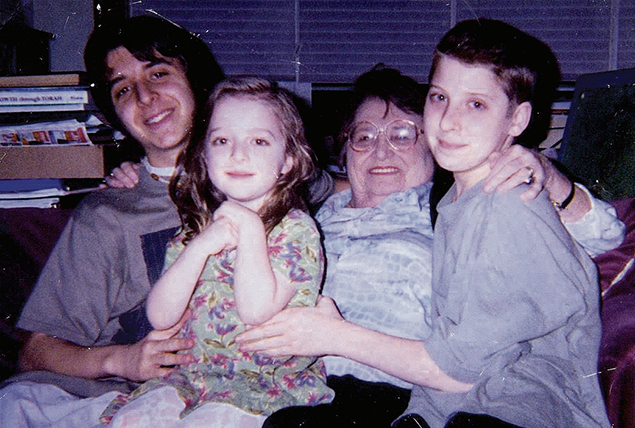
It began when they were children. They spoke Yiddish as well as English; they were theater kids and consummate performers. “Our family always burst into song at any family gathering,” Avram said; those gatherings would include their two cousins, Lee and Missy. “We’d sing Tom Lehrer and Gilbert and Sullivan, and musical theater, and also Yiddish songs. We’d always end with a Yiddish Holocaust song.”
“We each had our own repertoire of songs, and we’d each sing one, and then it would be ‘next!’” It would be the next person’s turn to perform. “We were all singing for our bubbie,” Elisha said; the kids would always include a number from a performance they’d been in. “So I always had to sing the Pharaoh song,” from “Joseph and the Amazing Technicolor Dreamcoat.”
“And Missy would have to sing a song from ‘Les Miz,” Avram added.
Some songs would be in English, others in Yiddish. “It’s funny,” Avram said. “Because we grew up speaking Yiddish, I didn’t realize that the attitude in the more traditional community was that Yiddish was a dying language. I didn’t know that until I was older.”
Similarly, he continued, the family of course always sang Chanukah songs for that dead-of-winter holiday, and one of those songs always was “Light One Candle.” In English. “I didn’t realize that the song wasn’t part of the mesorah,” he said. The tradition. Because it was part of the family’s tradition.
“A couple of years ago, I had the idea to translate it into Yiddish, and I tapped — no, roped — no, pressured — no, convinced! — I convinced Elisha to join in,” Avram said.
“My siblings are both professional musicians.
“Sarah, who is our baby sister, is studying in Rimon, a conservatory in Israel,” he continued. Rimon School of Music, in Ramat Hasharon, is arguably the country’s biggest and best-known place for professional musicians to study a wide range of modern genres. “She was a big star in Zamir,” the Jewish chorus, “and she went to the Berklee College of Music before she made aliyah and got married.” But she was back in Teaneck, visiting her parents, when her brothers convinced her to join them in “Light One Candle.”
“Elisha is a filmmaker and percussionist and a founding member of Zusha,” the neo-chasidic band, Avram continued.
Avram, the only of the three who is not a professional musician, is a rabbi, social activist, and teacher.
“We all love to sing together,” Avram said. “Whenever we sit together around the Shabbes table, we sing. It doesn’t happen too often anymore, because we’re not all in the same place, but we love it when it happens.
And we all have strong opinions. Very strong opinions.” Which, he implied without saying, often get aired at that table.
“So it was a question of convincing everyone to do the song.”
The translation “is not direct,” Avram said. “It is an interpretation. I say this whenever I teach — every translation is an interpretation. And it’s just about the rhyming structure” — because no two languages align well enough so that the rhythm of a sentence and the rhyme at the end, married to an exact translation of the words, is possible. “It’s also about the ideas. And I do think that the idea in ‘Light One Candle’ resonates across the languages.”
What’s the idea? “That darkness is abundant, wherever you look,” he answered. “It’s not difficult to feel the despair of the moment, whether politically or in our inner lives. Whatever the challenge has been, it is historically true for our people to nurture the light.
“There are stories in the Talmud about lighting the menorah. Times are unsafe, but we still are not free from the obligation to light. It’s about how you adapt to the times; how you light, where and maybe when you light.
“And then, when you’re out on the street and you see another person’s candle lit, you can say a blessing even though it wasn’t you who lit it, because the light itself is so powerful and inspiring. That’s the story of Chanukah and the transcendent power of light. Even just one light.
“Just literally one candle can dispel so much darkness.”
The light from the candle can be both general and particular, the Mlotek brothers said. “On the one hand, Chanukah is the holiday of the dedication of the ancient Temple. It’s about the land of Israel and celebrating the Maccabean victory over an occupying force. The chasidic and kabbalistic ideas of light are universal. Yiddish can dwell in both those arenas, the particularistic and the universalistic.”
And of course Yiddish, the spoken language of a vanishingly minuscule percentage of the world’s people, is inherently particular. “It’s a Jewish language,” he said.
The original song, like the Yiddish version, “is about perseverance, resistance, and hope, and that was relevant then and is relevant now. And we wanted to sing a song that was in solidarity with all suffering, and was a form of spiritual resistance against all oppression, especially from our own legacy of Yiddish culture and Yiddish musical advocacy.
“That’s what this song is doing.”
“Light One Candle” was written in 1982, in response to the war in Lebanon, but it became an anthem by American Jews demonstrating for the freedom of Soviet Jews. Again, it mixed the specific with the particular.
Everything in the Jewish world connects. The Mloteks recorded the song in musician C Lanzbom’s home studio, Sherwood Ridge, in Pomona, in Rockland County. (Mr. Lanzbom, a Grammy-winning musician who plays Jewish music, was a founder of Soulfarm.)
“I knew that C would connect with the song as a folk song, and that he also would connect with it as someone who appreciates the Jewish perpective, jewish history, and Jewish art,” Elisha said. “He was wonderful to work with. He plays guitar on the track, and I play percussion.
“And C’s wife, Cindy, told us that she remembers going to a Peter Paul and Mary concert and them performing it. We were working on our harmonies in her living room, and she came in to tell us that.
“It was the day that the hostages were released. That was on our minds. It was on everyone’s minds. That moment, and thinking about it in the context of Soviet Jewry’s lack of freedom, was powerful.”
As the English translation of the Yiddish translation of the English original puts it:
“Don’t let the lights go out!
“They flicker for generations.
“Don’t let the lights go out!
“Our singing keeps them aflame.”
The song is on YouTube.