

Teaching the Holocaust to G3 and G4
Sarah Coykendall prepares the next generations to confront and combat hate
Sarah Coykendall decided she wanted to be a Holocaust educator when she was in 10th grade.
It was the early teens, and Ms. Coykendall lived in upstate New York.
“In my sophomore year in our English class we read ‘Night,’ the memoir by Elie Wiesel,” about his experiences in Nazi concentration camps, she said. “I had a really average life, I would say, and so reading this book, it really stuck out to me, not only the suffering that people endured because of the actions of other people, but also the resilience that people had and how they could rebuild after such an unimaginable tragedy. And that really stayed with me as a 16-year-old who lived a normal life. And so I knew in that moment that I wanted to study the Holocaust, and I wanted to educate people about the Holocaust and about other genocides.”
Ms. Coykendall is not Jewish and does not have any familial connections to Holocaust survivors. “I was just really drawn to Holocaust studies because antisemitism is the longest hatred, and Jewish people have had to suffer unimaginable horrors before the Holocaust, during the Holocaust, and after the Holocaust, unfortunately,” she said. “And so this was something that I was very passionate about bringing awareness to and advocating for,” especially in finding methods of combating contemporary forms of antisemitism.
Now the managing assistant director of Kean University’s Holocaust Education and Resource Center and its Human Rights Institute, Ms. Coykendall works with middle school and high school students and teachers throughout the state. She also teaches undergraduates.
“We learn lessons from each facet of history,” she said. “When it comes to the Holocaust, it’s about our fundamental humanity. It’s about our shared experiences and how we can learn about things such as prejudice and equity. And we talk to students about resistance during the Holocaust, whether that was fighters in the forest, taking forms of active armed resistance, or resistance where they were having schools in the ghettos and still feeling empowered to have education or to practice their holidays when the Nazis didn’t want them to, and they had to do it in secrecy.
“So it’s really about bringing students to an understanding that the things that they think about today and have in their own lives were things that people were trying to preserve during the Holocaust. It’s about bringing students to an understanding that we can relate to one another, combating this prejudice and this hatred that continues to exist. It’s about what we can do today to help ensure that doesn’t happen to others.”
In early 2023, a couple of New Jersey middle schools approached Ms. Coykendall. “They were experiencing antisemitic acts, such as graffiti or commentary among students, and so they asked if we could give a presentation on contemporary antisemitism and how to address it,” she said. “We didn’t have one in our repertoire, so we created one.” That was in March. “And by June, when the academic year was over, we had given that presentation to more than 2,000 students. And so addressing antisemitism became part of the work in our continuation and our growth as a Holocaust education and resource center, to incorporate forms of bias and prejudice and hatred, including antisemitism.”
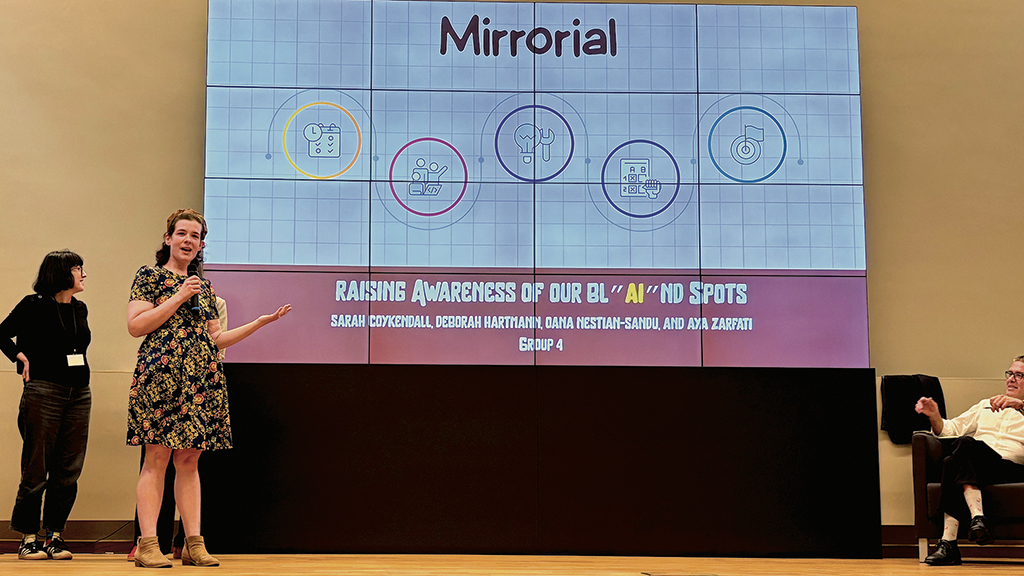
Ms. Coykendall recently was selected to participate in the Rethinking Holocaust Education fellowship. The yearlong fellowship, a joint program of the Ghetto Fighters’ House Museum in northern Israel and the Auschwitz-Birkenau State Museum in Poland, brings together Holocaust educators and scholars from around the world. The approximately 30 fellows are working in subcommittees focusing on different issues. Ms. Coykendall’s group is considering the future of Holocaust education and how it can be used as a tool to combat contemporary antisemitism.
“We are coming together with different backgrounds and experiences and content knowledge and the way that we share education,” Ms. Coykendall said. Two of the other scholars on the subcommittee live in Germany and are based at the House of Wannsee outside Berlin. The third is Romanian and works at the Olga Lengyel Institute for Holocaust Studies and Human Rights (TOLI).
“House of Wannsee is a museum, TOLI is a resource and education training center, and the work I do at Kean is predominantly teacher and student training, but also commemorative and community programming and archives and research as well,” she continued. “So we are coming together in a yearlong program where we have monthly meetings on Zoom, and we are creating a project, and we will have all year to implement that project with the teachers that we serve.”
At the end of the program, when the cohort travels to Israel together in the fall of next year, “we will report back with the Ghetto Fighters’ House Museum and the Auschwitz-Birkenau State Museum to demonstrate what we have found.”
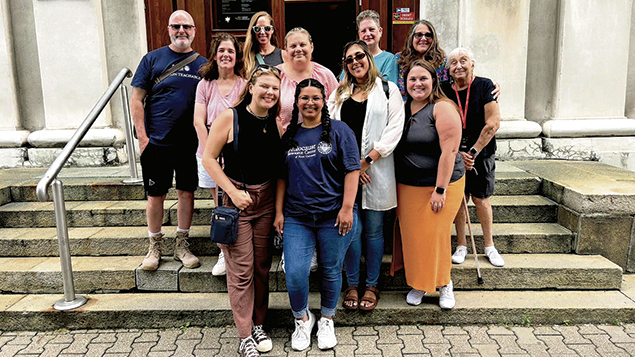
Ms. Coykendall also sees the fellowship as a valuable opportunity to connect with other scholars and enrich the Kean center’s programming. “As part of the center’s work, we take students and teachers abroad for a program called ‘Lessons of the Holocaust,’” she said. “In 2024, we went to Poland, and in 2026, we’re going to Berlin. We had planned this before I got this fellowship, but now that I have this connection to the House of Wannsee, we are going to go there and to have a more enriched experience.
“When I started” at the Kean center, about seven years ago, “my role really pertained to 3G, to how will the third, and now the fourth, generation carry on Holocaust memory and legacy, when we unfortunately exist in a post-Holocaust-survivor era, because we know the Holocaust survivors are aging and won’t be with us for more than 10-plus years. So how will Holocaust education continue? And it’s through 3G, 4G, but it’s also through the education that we receive and that we educate students and teachers with.
“As part of this fellowship, we are working to answer the question from a different lens. Yes, it’s the 3G and 4G and Holocaust education, but it’s also about bringing awareness to contemporary antisemitism and other forms of bias and prejudice that I think is really powerful.”