

All are responsible — Delaney Hall and the Jewish community
As we walked from our cars through the hospitality tent toward the small piece of pavement where we would hold a prayer vigil for the detainees in Delaney Hall, we saw a young woman park her car and run across Doremus Avenue into the arms of a young man (her husband, boyfriend, brother?).
We learned that 20 inmates had suddenly been released just hours before and realized that we were witnessing a reunion as this young man, ankle braceleted, crossed the street to return home. How long had he been incarcerated in this holding cage from hell? How had his loved ones coped with the excruciating pain of losing him to this unpredictable, frightening place? All of us cried just a little at witnessing this moment of relief and gratitude.
Why was a small group of congregants and rabbis from Congregation Agudath Israel gathering on a Thursday evening between Rosh Hashanah and Yom Kippur in this godforsaken place?
Rabbi Abraham Joshua Heschel wrote: “In a free society, some are guilty, but all are responsible.” That distinction — between guilt and responsibility — is why we were there. It is the lens through which the Jewish community of New Jersey must see what is happening a few miles from our synagogues, at the Delaney Hall Detention Center in Newark.
Get New Jersey Jewish News's Newsletter by email and never miss our top stories Free Sign Up
None of us built Delaney Hall. None of us wrote or implemented the policies that allow it to be filled. But we are responsible for ensuring that it stays in the public eye and not allowing it to quietly become a degradation that New Jersey has learned to live with.
Delaney Hall is a privately run, 1,000-bed ICE facility. Since last spring, detainees have staged hunger and labor strikes over contaminated food, denied medical care, and forced labor paid in dollars a day. Three men have died in custody — Jean Wilson Brutus, Edwin Lopez-Cornejo, and José Chajón-Raxón, the latter two only weeks ago. State health inspectors have been denied entry to the facility’s medical units, prompting the New Jersey Attorney General to sue for access.
Not only do these inhumane policies impact the detainees, but their families also are mistreated. Facing the emotional and financial hardship of losing a family member, often a primary wage earner, to detention and potential deportation, these families have been subjected to arbitrary and ever-changing visitation rules.
This is not a hypothetical. It is a documented, escalating pattern, and it is occurring just minutes down the New Jersey Turnpike from where we live and where we pray during the High Holy Days.
While we may question and disagree with the current immigration policies in the United States, that is not our focus. We choose to focus not on immigration politics, but on policies that allow detainees to wallow in inhumane conditions and their families to be treated in a disgraceful manner.
The danger now isn’t that people will defend these conditions outright — almost no one will. The danger is quieter: a community that reads about a death at a detention center in its own backyard, feels a flash of outrage, and moves on to the next headline. If we let that happen, we lose more than our outrage. We lose our baseline humanity. And we lower the bar for what we’ll tolerate the next time, and the time after that — in Newark, and everywhere.
Long before most of us paid attention, Pax Christi, a global Catholic peace organization, has been there every day, leading an interfaith support effort. Under the leadership of Kathy O’Leary, the coordinator of the New Jersey region, Pax Christi has maintained a continuous presence at Delaney Hall’s gates: a “Radical Hospitality” tent supplying families with food, water, and even a change of clothes when arbitrary deviations in unwritten dress codes are used to deny entry to visiting families.
While the Jewish community did not start this work, we have been privileged to follow Pax Christi’s lead, initially in small numbers and then, as the summer wore on, in growing ones. Among the first members of the Jewish community to step forward may have been Rabbi Anne Laurent, a hospital chaplain living in Montclair who volunteers weekly at Delaney Hall to counsel families as they arrive to visit detained loved ones. On Tisha B’Av, Congregation Shomrei Emunah anchored a consortium of synagogues from Essex, Bergen, and Hudson counties, drawing more than 120 congregants to sit outside the facility, sing psalms, and chant Eicha (Lamentations), explicitly linking the ancient lament for a destroyed Jerusalem to the modern-day plight of the people detained a few feet away. Rabbi Abigail Treu and the Oheb Shalom Social Justice Initiative Committee and Temple Emeth’s Social Action Committee have kept up steady tzedakah efforts including gift cards, toiletries, and food for families arriving to visit detained loved ones. Ahead of the High Holy Days, Congregation Beth El of South Orange held a Selichot service at the gates. And, as we understand it, Temple Ner Tamid will continue to host prayer events including one during Sukkot — “Sukkot Service of Solidarity” led by Rabbi James Feder and Cantor Meredith Greenberg.
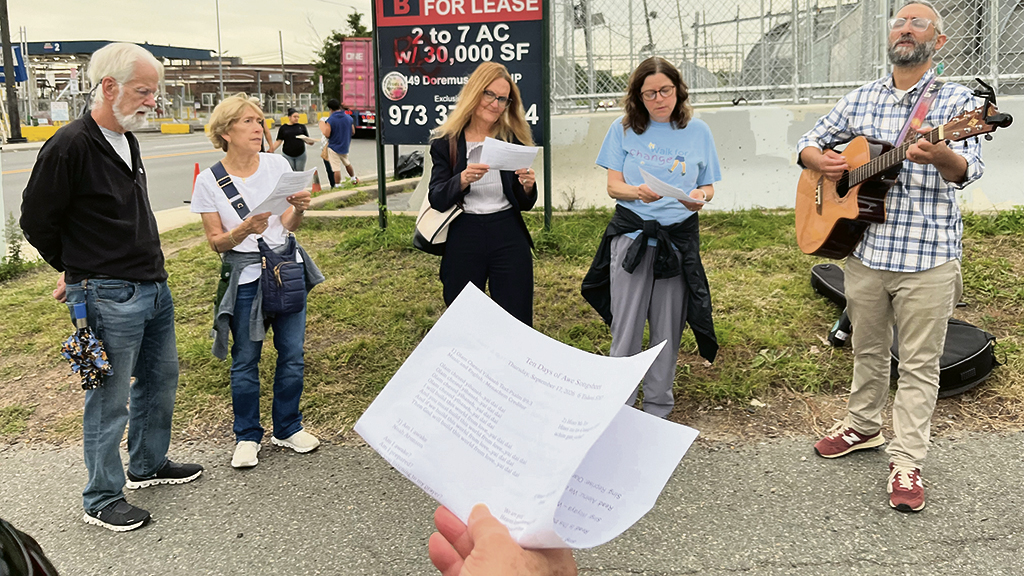
We are proud to be a part of this effort. During the Ten Days of Awe between Rosh Hashanah and Yom Kippur, Congregation Agudath Israel’s Tzedek Initiative organized a prayer service outside Delaney Hall’s gates. The timing was not incidental. Teshuvah, tefillah, and tzedeka, (repentance, prayer, and justice) are the themes of these days, and Jewish tradition has never confined them to our own households. Pidyon shvuyim, the redemption of captives, is a mitzvah gedolah, a weighty commandment, and a communal obligation. It was fitting, too, that the service fell on Constitution Day, a reminder that the Fifth Amendment’s guarantee of due process belongs to persons, not only to citizens, and that guarantee is being denied behind Delaney Hall’s fences.
We know that the response must be more than a single afternoon of song, prayer, and photo ops. It has to be sustained: gift cards and toys for families arriving to visit detainees, phone cards and commissary funds for detainees where permitted, and most of all, our continued, visible presence at the gates, alongside Pax Christi and the interfaith partners who arrived first and never left. Keeping Delaney Hall in the news is not a side benefit of this work. It may be the most important thing we can do.
Heschel’s teaching was never really about assigning blame. It was about refusing the comfort of distance. We are not guilty for what is happening right now at Delaney Hall, but we are responsible for what happens next.
We pray that 5787 will be a year of justice and compassion.
Morris Lewis of Caldwell is a native Mississippian; he and his wife, Stacey, have three sons and four granddaughters. They are longtime members at Congregation Agudath Israel, where he is on the board of trustees. Morris is a mostly retired pharmaceutical executive, an active amateur genealogist, and a board member of the Goldring/Woldenberg Institute of Southern Jewish Life in Jackson, MS, and the Museum of the Southern Jewish Experience in New Orleans.
Rabbi Paula Mack Drill of Caldwell retired in June 2024 from full-time pulpit life at the Orangetown Jewish Center, where she served for her entire rabbinic career of over 20 years. In addition to fulfilling her blessed obligations as Bubbe to her grandchildren, she works quarter-time as Rabbi in Residence at her home community, Congregation Agudath Israel in Caldwell, and serves as mentor to JTS Rabbinical School mekhinah students.