

How brave are you?
‘Aftermath’ takes a deep dive on what happens after trauma
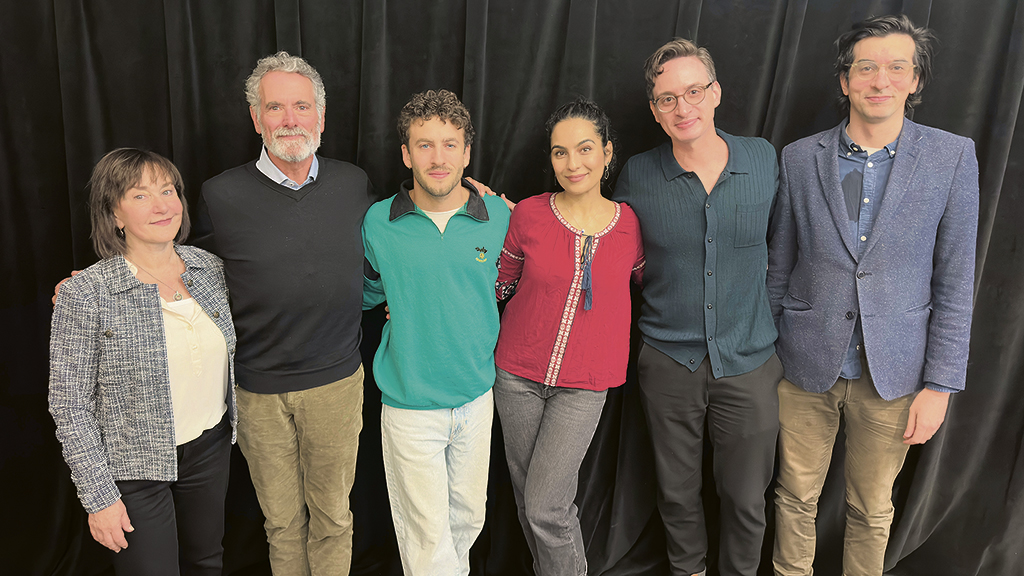
After a harrowing experience overseas, Josh Goldman is back living with his parents in an upscale Washington, D.C., neighborhood. A freelance journalist on assignment in Afghanistan, he’d been captured by the Taliban but improbably managed to escape. His translator, though, was murdered.
Following a regimen set by his doctor and his mom, he is slowly recovering, physically and mentally. “It’s been more than six weeks now, and I’m doing fine,” he tells his lawyer-turned-lobbyist father, Allan. “My appetite’s back. I’m sleeping through the night.”
That’s the setup for David Zax’s play “Aftermath.” On the surface, at first it appears to be a straightforward and presumably inspirational story about recovering from disaster under the watchful eye of loving parents.
But “Aftermath” is anything but predictable. In fact, it offers a nuanced and thoughtful plot fueled by more hairpin curves than the mountain roads leading to Kabul.
Ironically, while that makes the play satisfying and enjoyable to watch, it makes it difficult to write about, for fear of inadvertently revealing some of the several surprising and dramatic twists. So I leave it to playwright Zax, 42, to explain the drama and its genesis:
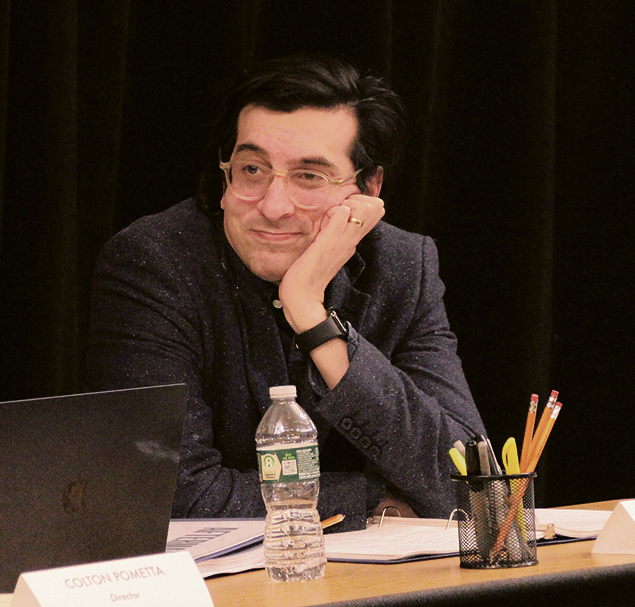
“I was a journalist for many years,” Mr. Zax said in a Zoom interview from his Brooklyn co-workspace. “I was always a kind of dorky wallflower science and technology journalist. But I had a dream of being more adventurous.
“One day I got a call from Foreign Policy magazine offering to send me to a dangerous corner of Honduras to report a story. I thought this was my chance to do something courageous and to prove something about my masculinity.
“I did some research and discovered that the risk of being kidnapped was negligible in this corner of Honduras. I sort of caught myself doing — we’ll have to avoid a spoiler here, so I’ll couch it in less spoil-y terms. I caught myself doing sort of a calculous of who would suffer the most if I was kidnapped. And I caught myself still tempted to go. According to Mr. Zax’s math, the chance of being kidnapped in Honduras were slim. And the odds that he would be killed were longer still. “The incentives are in place actually to keep me alive, to transact money from the transaction,” he said.
“Thankfully, unlike my protagonist, Josh, I caught myself before I made a blunder, and decided not to go. Meanwhile, I was studying with the great playwright Annie Baker at NYU Tisch. I had to come up with a play idea. I decided not to go to Honduras and not to be the heroic journalist I dreamed of being and instead write a play about what might happen if an adventure like this went horribly wrong.”
I wondered what impact that decision had on him. “I think it was the moment, it probably was the turning point for me when I decided to abandon my dream that I was going to be a war correspondent or was ever going to be the kind of journalist who bears witness to trauma and exposes himself to the risks and dangers of the people that he writes about. It was the moment I think I turned to a more kind of fiction writing playwright version of myself, and accepted that.”
Accepted what?
“I accepted that I was a coward.”
Taken aback for a second, I wonder if that’s a joke.
“No, it’s real,” he told me. “I accepted that I was a coward.
“In the play there is this line about Josh diving away from the plate because a fastball comes too close. That’s a memory from my life. Even in the mostly Jewish school I went to, I was the least kind of masculine and sports-literate of the bunch. So it’s who I am, and I sort of accepted that about myself.”
We begin to talk about his family, but Mr. Zax interrupts:
“There’s one more thing I want to say from a Jewish standpoint, if I may. The play is not overtly Jewish, but it is about a Jewish family and poses a Jewish question. It’s this conversation about tikkun olam, the notion of healing the world.
“The play asks the question of where we draw the circles of our sympathy. Should we love someone across the world as much or less than our family members? If less, how much? I think in that sense it is a Jewish play.”
I suggest that the play could have worked as well if the characters were not identifiably Jewish, to which Mr. Zax replies:
“I simply tend to write Jewish characters because I am Jewish, I know the world, and I know the rhythms of speech.”
These are rhythms he picked up in Sunday school at Adas Israel, the Conservative Washington, D.C., shul where he was a bar mitzvah. Subsequently the family “self-demoted” to a Reform temple, Washington Hebrew, where his younger sister had her bat mitzvah. “I don’t consider it a demotion, but we kind of went on a trajectory of reforming ourselves,” Mr. Zax said.
His father, Leonard, a Paterson native, was a real estate lawyer who moved into economic development and advocacy toward the end of his career. He became the CEO of the Hamilton Partnership for Paterson, which, David explains, “was instrumental in getting the Great Falls of Paterson designated a national park and historic site and securing all kinds of funding to develop the region there.”
Mom Helen was a lawyer with two master’s degrees who, when Leonard made partner, “decided to stay home and found the job of being a mom more rewarding than being a lawyer.” She still built a successful career as an award-winning children’s book writer.
Finally, if the plot as described sounds at all familiar, that’s because it was produced several years ago under the name “The Room Where I Was Held.” “But now that it’s having a grander life, coming to New York, we renamed it ‘Aftermath,’” Mr. Zax said. “That was a choice made in collaboration with my producers. We thought it was a simpler, catchy-er title. Same play, though.”
“Aftermath” runs from October 19 to November 8 at the A.R.T./NY’s Mezzanine Theater. Tickets are available at aftermaththeplay.com.