

From rebbetzin to rabbi
Marge Wise now focuses on conversion, bringing other people closer to Judaism

Margery Beltzer Wise’s life has taken unexpected turns, but there’s a strong, straight line running through it. Whatever she does, it’s connected to Jewish life, Jewish faith, and the Jewish world.
But those turns — she’s done some major slaloming.
Ms. Wise was born in the Bronx, but she and her parents, Beverly and Carl Beltzer, soon moved to Queens. She grew up in Whitestone, the quiet residential neighborhood on the borough’s north shore. The family joined the Whitestone Jewish Centre, and little Marge loved it. “I had a bat mitzvah on a Friday night in 1962,” she said; it was unusual then for a Conservative synagogue to allow a girl to celebrate becoming a bat mitzvah “but I had at least three other friends who also had one,” she said. “It was a fabulous experience. I went to Hebrew school and Hebrew high school there, and I loved it. Maybe that was unusual. Maybe that presaged my future.”
When she was 16, the shul “called a meeting to explore opening a USY chapter.” USY is United Synagogue Youth, the Conservative movement’s youth group. “I went to the meeting, and I was hooked. And before I knew it, I was going to kinnusim” – regional meetings — “Shabbatonim” — more local overnight Shabbat celebrations — “and dances.
“That was the turning point in my personal religious experience. I am an only child. My parents were strong, proud Jews, but we were not observant. We would go to synagogue every Friday night, and then we’d go to the ice cream parlor.”
Soon that changed.
“I asked my parents if we could keep kosher. We had not until then. And they said sure. And we did.”
Her parents both were born in the United States. Their families kept kosher when they were kids, so although they’d moved away from the practice, they knew how to do it.
“The next step was that I wanted to be shomer Shabbat.” Sabbath observant. “It was just so natural. One thing just flowed to the other.
“I became USY chapter president, and then I went to Queens College, lived at home, majored in Hebrew studies and minored in education, and my synagogue asked me to be the youth leader. And we started a Kadimah group” for middle schoolers.
“It was all very seamless. I loved it. I just loved it. One of the greatest things was taking kids to kinnusim and sharing with them the ruach” — the spirit — “and the beauty I’d found.”
She also had influences outside the Conservative movement. “The Torah Leadership Seminary, a coed program run by NCSY,” the Orthodox Union’s National Council of Synagogue Youth, “had a big effect on me too,” Rabbi Wise said. “It was one week at the end of the summer, and I learned so much. Shlomo Riskin was one of the rabbis — he was Steven Riskin then, and he introduced me to the Student Struggle for Soviet Jewry. That was a very big part of my life. They sent me to high schools to speak to students about Soviet Jews. That was such a big part of my life then.”
Altogether, “I think that set the stage for my marrying a rabbi,” Rabbi Wise said.
And yes, that’s what happened next. Two months after she graduated from Queens College, not quite 21 years old, Marge Beltzer married Rabbi Joseph H. Wise.
They were not a conventional couple. Joseph Wise was 30 years older than Marge Beltzer. When she was a kid, “he was the rabbi of the Whitestone Jewish Centre. Then he left Whitestone, and I grew up, and then he took the pulpit of the Northeast Jewish Center in Yonkers. Later, we reconnected.
“And we fell in love.”
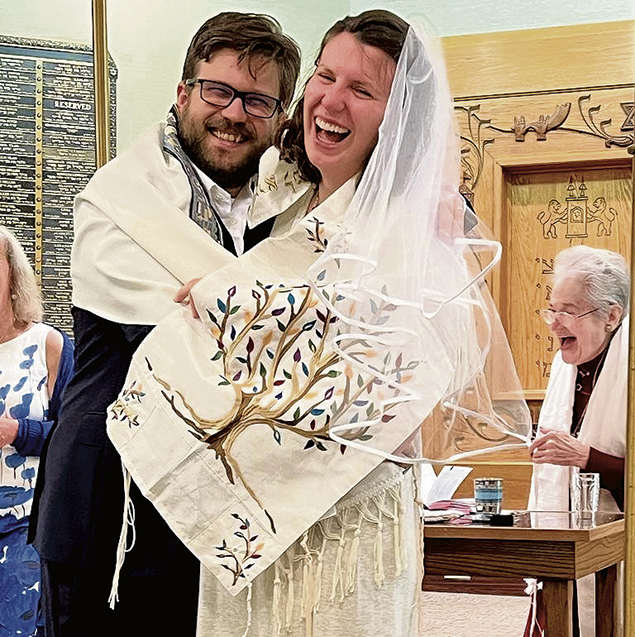
They married in 1970. Joseph Wise held his pulpit in Yonkers for 30 years, from 1966 to 1996.
“The age difference was not an issue for us,” Marge Wise said. “I worked side by side with him. The seeds of my own rabbinate were sown then.”
Rabbi Wise now has two children, eight grandchildren, and one great grandchild.
Ten years into the Wises’ happy marriage, however, everything changed, slowly at first, then faster and faster. “My husband developed dementia,” Rabbi Wise said. “No one wins that battle.”
To add to her distress, “my father died of a sudden massive coronary at 61, and then months later my husband was diagnosed.
“I stepped up and stepped in. I wanted to make his functioning last as long as possible. As his cognitive decline continued, I tried to do more and more. For example, he would have a funeral. I would be on the phone with him when he did the intake. I would take notes, and I’d write them in large letters, because he had some difficulty reading.
“We were in a fishbowl. The rabbinate is a fishbowl. I could step in, but only behind the scenes. Anything that I could do behind the scenes, I did.”
People started to notice, Rabbi Wise said. When her husband spoke, sometimes “he would falter. You could tell that he had been a great orator, a really great preacher. The change was gradual but perceptible.
“I learned a lot in those years. Eventually, sometimes I would be called on to officiate at a funeral, as it became obvious that he was becoming less and less able.
“His illness spanned 14 1/2 years,” she added.
“I stepped up, but my children did everything. My children are the heroes of this story. And my mother was incredibly good to us. She did everything for us. She helped us financially. At the end, she fed my husband lunch every Sunday.”
Money became a problem for the family. “I needed to earn some money as my husband’s illness progressed,” Rabbi Wise said. “I started to work as an assistant teacher at SAR,” the Orthodox day school in Riverdale, just south of Yonkers. “I taught first, second, and then fourth grades, and it spanned three years.
“And then an opportunity opened, and I was hired to be the manager of a store called the Jewish Quarter in White Plains. It sold Judaica and fine arts.” Her mother, who had been a public school teacher in Queens, retired from that job and worked with her daughter.
A year later, the owners moved to California and sold the store to her and her mother, and they partnered together for years. But Rabbi Joseph Wise died in 1996, and Ms. Beltzer died in 1999, and after that it wasn’t the same for Marge Wise. And as she grieved, she also saw that the environment had changed. Online shopping was beginning to affect brick-and-mortar retailing. All things considered, it was time to find a new career, so Rabbi Wise closed the store in 2000.
Looking back, she saw that “it was beautiful working there. “It gave me the opportunity to enrich people with beautiful Jewish art. It was hard work — we worked six days a week — but it was living hiddur mitzvah,” beautifying the commandments visually and spiritually. “I loved it.”
For her next act, Marge Wise became a synagogue executive director; her experience in Yonkers taught her to do the job. For many years she worked in Congregation Sons of Israel in Briarcliff Manor, N.Y., and at Congregation Shomrei Emunah in Montclair; she took a master’s program in pastoral counseling at Iona University in New Rochelle during that time. “It was for clergy and clergy wives,” she said. “It was tailor-made for me. It was a fabulous program, and I met people there who really enriched my life.”
In between those two jobs, Rabbi Wise started rabbinical school at the Academy for Jewish Religion, the nondenominational rabbinical seminary in Yonkers. She loved it. But she couldn’t pursue it for very long then. “I needed a parnassah,” she said. She had to make a living. She needed an income.
Although she enjoyed being a synagogue executive director, the field changed in a way that was less comfortable for her. It became more administrative as synagogues needed more and more administration.
“In 2014, I was courted by the admission chair at AJR,” Rabbi Wise said. “She kept saying, ‘Nu? Nu? Apply already!’” Eventually she did. She began taking courses at nights, and then on Sunday mornings. When her job in Montclair ended, she began a similar one at Neve Shalom in Metuchen; she commuted to AJR from Middlesex County. “And then covid hit,” she said.
Rabbinical school went online. Rabbi Wise became a full-time student, and “I worked day and night.” She wrote a thesis, “Synagogues in Crisis: Model of the Covid Pandemic.” The result of many interviews with synagogue professionals across the country, it was a resource book on survival techniques. “I finished all my requirements, took my comps, presented my thesis, did everything on line — and I was ordained, online, on May 6, 2021.”
Like candidates about to get smicha in person, AJR’s online students picked their own presenter. Rabbi Wise’s was Rabbi Aryeh Meir of Teaneck.
Her transition from rebbitzin to rabbi was complete.
During that time, Rabbi Wise moved to Caldwell, where she lives now; she’s an active and avid member of Congregation Agudath Israel there. She’s a member of the Conservative movement’s Rabbinical Assembly.
Now what? “Keruv,” Rabbi Wise said. “Outreach. Keruv and teaching are my passions. I worked hard to break into the conversion field, and I work with many prospective Jews by choice.
“I have long been troubled by the off-the-charts intermarriage rates,” she continued. “I feel that these families are slipping between the cracks precipitously, and I want to try to save some of them.
“I don’t mean that in a grandiose way. I want to work with people who might be seekers. As Jews, we don’t solicit. We don’t missionize. But we welcome seekers. I want to be available to seekers, and in interfaith families there are a lot of seekers.”
Rabbi Wise calls herself the Journey Rabbi, because she knows that her students, the seekers, are on paths of discovery — self-discovery and the discovery of Jewish wisdom, history, truth, and life. She details some of that on her website, journeyrabbi.com.
“There are four basic reasons why my students convert,” she said. “First, many feel that Judaism is community, and many of them want that. Many of them have had Jewish friends, see their Jewish families, have attended bar or bat mitzvahs, and felt the connection.
“A second reason is that somehow, they never connected to their own birth religion. I have a student who said that he felt that he had finished with Christianity when he was 17. He’s only 20 now. When he saw a podcast about someone who had converted to Judaism, it clicked for him.” He got in touch with Rabbi Wise, and their study began.
“A third is the feeling that you can ask me anything, and in the church they never had that feeling. We can talk directly to God.”
The fourth reason is “October 7, which has been a massive catalyst for many of my students.”
Rabbi Wise’s conversion students come from all over the country and the world — New Jersey, Vermont, Washington, Florida, California, Illinois, Rhode Island, Pennsylvania, and Alaska; Canada, Switzerland, Sweden, Australia, Philippines, Brazil, Spain, Mexico, and the U.K. Many come from intermarried families, and “I have a number of LGBT students,” she said. “They say that they find Judaism more welcoming. I had a trans student who said that the mikvah washed away the bad experiences they’d had with their original religion. It truly was a rebirth.”
It’s mainly online, but the mikvah and beit din are in person. And the process doesn’t have to end with conversion. She keeps in touch with her students, and they can develop close relationships. “I have brought 10 students to completion, and there are 14 in the pipeline,” Rabbi Wise said. “My students inspire me every single day.”
Although everything else she does is egalitarian, the three-rabbi beit din — the rabbinical court — that she assembles, as halacha demands, to complete a conversion, is always made up of three men. “I convene an all-male beit din, with rabbinical colleagues, because I feel I have to be more strict in my practice so that the beit din will be a little more respected.
“My motto is conserve, commit, transmit,” she added.
She tells a story about her granddaughter, who was 5 when she said, “Girls can’t be rabbis.” Yes, they can, Rabbi Wise said, but her granddaughter, who was unconvinced, said, “They can be rebbetzins.”
That’s when her daughter-in-law ended the discussion. “Grandma’s been there, done that,” she said.