

Hath not a Jew infinite layers of complication?
Saul Rubinek does and doesn’t play Shylock, for reasons ‘Playing Shylock’ explores
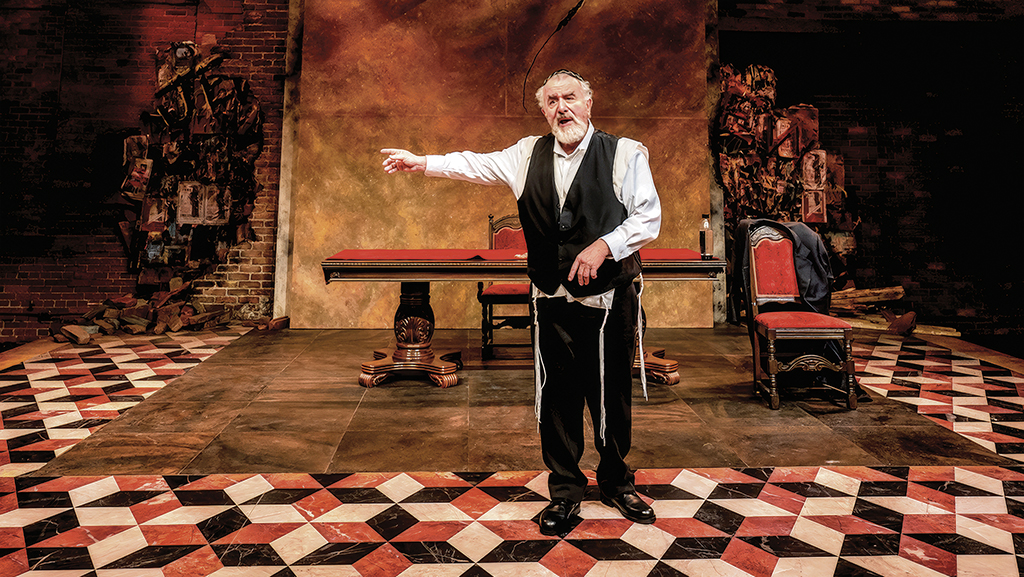
At the start of “Playing Shylock,” Saul Rubinek comes on stage in full chasidic gear: the payess, the long black coat, the tzitzit. But he is not in a very religious mood.
While it reads more complicated than it — you should pardon the expression — plays out, in this drama the actor Saul Rubinek plays a character named Saul Rubinek who has been cast as Shylock in “The Merchant of Venice.”
As it happens, the two Rubineks have very similar biographies. Both were born in a DP camp in Germany to parents who ran a Yiddish theater in their native Poland, both emigrated to Canada, both became successful actors.
But unlike the real Rubinek, the character Rubinek actually gets to play his dream role. Or he almost does. But this “Merchant” is shut down because of pressure from the woke. And Character Rubinek faces special pressure because how dare a Jew participate in this antisemitic play?
The play’s closing wasn’t supposed to be announced until the next day, but news leaked out, and Character Rubinek discovers it during intermission. That’s why he comes out fully dressed in costume, not only to tell the waiting audience that he will not perform the second act of “Shylock,” but also to tell them why.
It is a tour de force performance in a timely production. Real Rubinek is on stage for 100 minutes, alternately angry and saddened by the state of affairs. Now, to talk to me, he Zooms from the apartment he’s renting, just a five-minute walk from the Polonsky Shakespeare Center in downtown Brooklyn where he will perform the play through December 7.
I ask him about its history. All I know is that the original was produced in the mid-1990s without Saul Rubinek, either real or fictional. And as I quickly discovered, Mr. Rubinek doesn’t talk in sentences.
He talks in paragraphs.
Chapters, really.
Playwright Mark Leiren-Young was doing a radio series in Vancouver called “Dim-Sum Diaries,” “a mocumentary about anti-Asian prejudice,” Real Rubinek said.
“At the time, he was censored for doing it. They didn’t call it cancel culture in the ’90s. He was furious and decided to write a play about a show that was canceled. He wanted to do it about an ‘Othello’ canceled by people upset that maybe somebody playing Othello wasn’t Black. But a friend asks him: What the [heck] do you know about African-Canadian culture? Why don’t you do it about Shylock?
“So he wrote a play called ‘Shylock’ in the ’90s, about an actor, a fictional actor, who’s playing Shylock, and the show gets canceled. That version started as if it’s a talkback with the audience at the end of the show. And it played successfully in different parts of Canada, the United States, and even in Europe.”
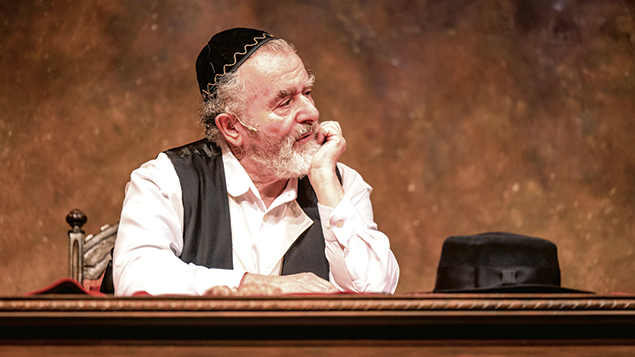
That was in the 1990s. The story resumes in 2020.
“I met Mark Leiren-Young 30 years later,” Mr. Rubinek said. “We were in covid lockdown, disinfecting vegetables and bored out of our minds. I didn’t know him, but a mutual friend introduced us and said, ‘You guys should talk.’
“Mark had a project that he wanted me to do, a film adaptation of a play that he had written called ‘The Bar Mitzvah Boy,’ about an older Jew who’d never been bar mitzvah and wants to be bar mitzvah in his 70s. We started to talk about that, and that led him to tell me about this play, ‘Shylock,’ that he had really wanted me to do 30 years ago, but the director had said that I was unavailable.
“I wasn’t doing theater at that time. I was mostly trying to make a living to support my new family, and so he never got it to me. He said, ‘I’ve never had this show done, in a major city,’ meaning Toronto or New York. And he thought that maybe I would be able to get this done there.
“He told me what it was about. I said, ‘Well, send it to me.’ So I read this play, and I didn’t like it at all.
“I understood why it was successful. It was funny. He’s a very funny writer. He’s the winner of the Stephen Leacock Award, which is the equivalent of the Mark Twain award for humor in Canada. He’s a children’s writer, he’s a screenwriter, he’s a playwright. I could see why it was successful. It was funny and moving.
“But there’s not one thing that he said about Shylock or ‘The Merchant of Venice’ that I agreed with, not one.”
Nonetheless, “I called him, then I went back on Zoom. I said, ‘I hope you’re not going to be insulted.’
“He just laughed. He was very amused by my reaction, because he’d already had a success with this many years ago. He said, ‘You know, I’m not surprised, because I didn’t give a shit about Shakespeare or about ‘Merchant of Venice.’ I was just using it as an excuse to vent about censorship. I’d be willing to rewrite it.’
“I said, I don’t think you understand, Mark. It doesn’t need a rewrite. It needs a write.’
“I had reconnected with this fellow, Martin Kitch,” who ended up directing “Playing Shylock.” “I had worked with him 15 years ago in Toronto but had lost touch with him. I asked Martin to read the play without telling him a word about what I thought. And he said exactly what I said.
“So we all three got on Zoom and Mark said, ‘I’ll rewrite it completely. I’ll start from scratch.’ And then I said, ‘Well, I have two ideas for you. The first is that it shouldn’t be a talkback at the end of the show. I think it would be far more dramatic if it happens in intermission, and the actor refuses to do the second half of ‘Merchant of Venice.’ Mark said, ‘Oh, I like that.’
“The other idea — and I don’t know how you’re going to feel about this — what if the actor playing the part of Shylock, instead of being a fictional actor, what if his name is Saul Rubinek, the child of Holocaust survivors, and he’s upset that people think that the child of survivors would do an antisemitic play?
“When I said that, this is what he did” — Mr. Rubinek stares into his computer screen and widens his eyes until they’re both the size of teacups — “and I knew at that moment, when I saw his eyes light up, we were going to have a play.”
Of course it wasn’t that simple. Mr. Leiren-Young needed cash to continue. So Mr. Rubinek got in touch with an old friend, one of the largest Canadian theatrical producers, who liked the idea and agreed to give the playwright a $20,000 advance.
“And what did Mark do?” Mr. Rubinek asked rhetorically. “He started to research every interview I’ve given like this one since 1980, my stories about my family, stories about my father in the Yiddish theater, my background, my career, my ability to speak Yiddish. And then he wrote a draft with Saul Rubinek stopping the show at intermission.
“But he did something else we hadn’t discussed, and he was very nervous about. In that draft, the reason Saul Rubinek is doing Shylock is his father never had a chance to play Shylock, and he wants to play Shylock as if his father were doing it, in a chasidic outfit and with the accent his father had.
“He was nervous I wouldn’t like it. But far from not liking it, I thought that it made the thing work, because what we wanted to do was not create a show or play that was a satire of cancel culture, or, like his first version of this play, as funny as it was, a diatribe against censorship.
“We wanted to go deeper, and his idea of my fictional Saul Rubinekn, wanting to play Shylock as a version of his father, made it very moving. You better understood why he’s upset that it’s been canceled, and that gave the play a heart.”
“Playing Shakespeare’” premiered in Toronto earlier this year, and everyone involved feared post-October 7 disruptions. Antisemitic violence peaked there over the last year, “more than there had been in 50 years,” Mr. Rubinek said.
But it didn’t happen, in part, as Mr. Rubinek modestly admits, because “I’m not a big enough star. I’m not like Dustin Hoffman doing it, a major star who attracts that kind of publicity-seeking protester.”
Also, the audience becomes a participant in the play. At times, Character Rubinek asks questions. Real Rubinek feels that this dilutes any desire to create turmoil.
The play is filled with great lines and provocations. For example, after discussing Jewish performers who changed their names (Bernie Schwartz to Tony Curtis; Betty Perske to Lauren Bacall, Jonathan Leibowitz to Jon Stewart), Mr. Rubinek says that he refused to change his name or nose.
“My parents didn’t survive the Holocaust so I could erase myself,” he says.
He’s no fan of Jewface, the relatively recent movement that argues Jews should be played by Jews. “I have no problem at all with Helen Mirren playing Golda Meir,” he said. “No problem at all with non-Jews playing Jews. I absolutely believe that playing who you are not is how we show our common humanity.”
And most interesting, he doesn’t think “Merchant” is antisemitic. “Jews didn’t exist in England for 300 years when this was written,” he told me. “You’re dealing with a 98% illiterate population taught by the Church that the Jews killed Christ. And they may not be human. They may have cloven feet. They may have horns. People believe this.
“But like I say in the play, the audience was not used to a character saying, ‘Hath not a Jew eyes? Hath not a Jew hands?’ They would have been stopped dead in their tracks.”
In the play, Character Rubinek delivers the famous speech — “If you prick us, do we not bleed? If you tickle us, do we not laugh? If you poison us, do we not die?” — as Shylock, and the transformation from Rubinek is startling and stunning.
“So,” Real Rubinek continued, “this is the first three-dimensional Jewish character in the history of all literature. Even though he’s a bad guy, he is a three-dimensional human being. And by the way, yeah, the Nazis, Goebbels, they cut those speeches when they put ‘Merchant of Venice’ on. They cut all the humanistic speeches, and they just made him a bad guy without any kind of depth or resonance.”
Saul Rubinek was nine months old when his parents left Germany for Canada. He’s written a memoir about their experiences, “All in the Telling.” Autographed copies will be available in the theater lobby; they’re for sale, unautographed, on Amazon.
Mr. Rubinek considers himself a cultural Jew, an atheist who doesn’t believe in organized religion. He had a bar mitzvah, but only as part of a bargain. He told his father: This means I’m an adult, therefore “I’m responsible for my own actions. You can suggest that I do my homework.”
At home, he and his family — his wife is not Jewish — celebrate all the holidays. “Because I’m in theater, I love all these rituals,” he said.